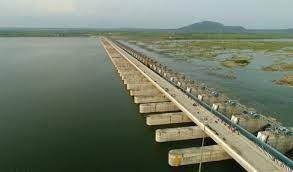
Telangana Dismisses NDSA Committee Report on Barrage as Unsubstantiated Hyderabad, Nov 5: The Telangana government has rejected the findings of the National Dam Safety Authority (NDSA) committee regarding the sinking of the piers of the Medigadda (Lakshmi) Barrage, a crucial component of the Kaleshwaram Lift Irrigation Project.
The state government believes that the committee’s comprehensive indictment of the Kaleshwaram project was hastily carried out. Rajat Kumar, Special Chief Secretary of the Irrigation and CAD Department, responded to NDSA chairman Sanjay Kumar Sibal’s letter dated November 1, which conveyed the committee’s findings.
The report, made public on November 3, attributed the sinking of the barrage’s piers to issues related to planning, design, quality control, and operation and maintenance. The report’s release sparked political controversy, with the opposition BJP and Congress using it to support their claims of widespread corruption in the Kaleshwaram project, which is touted as the world’s largest lift irrigation project.
Rajat Kumar expressed surprise at the conclusions drawn by the committee regarding the causes of the barrage’s failure without an in-depth investigation. He noted that the accurate causes can only be determined after a thorough inspection of the foundation and related structures, currently submerged underwater.
He called the comments related to poor quality control unsubstantiated, asserting that rigorous quality checks were carried out during the project’s execution. The NDSA committee’s observation that only 11 out of the 20 documents requested were provided was disputed by Rajat Kumar, who stated that all documents were shown to the committee during inspections and subsequent meetings.
The NDSA chairman was informed that a coffer dam is being constructed to divert water and facilitate a comprehensive inspection of the affected sections of the barrage.
In conclusion, Rajat Kumar asserted that the Kaleshwaram project has had a significantly positive impact on Telangana’s economy and ecology, leading to substantial growth in agriculture production, groundwater levels, fisheries, and tourism.
The dispute between the state government and the NDSA committee highlights the challenges in assessing and addressing dam safety issues in large-scale infrastructure projects.