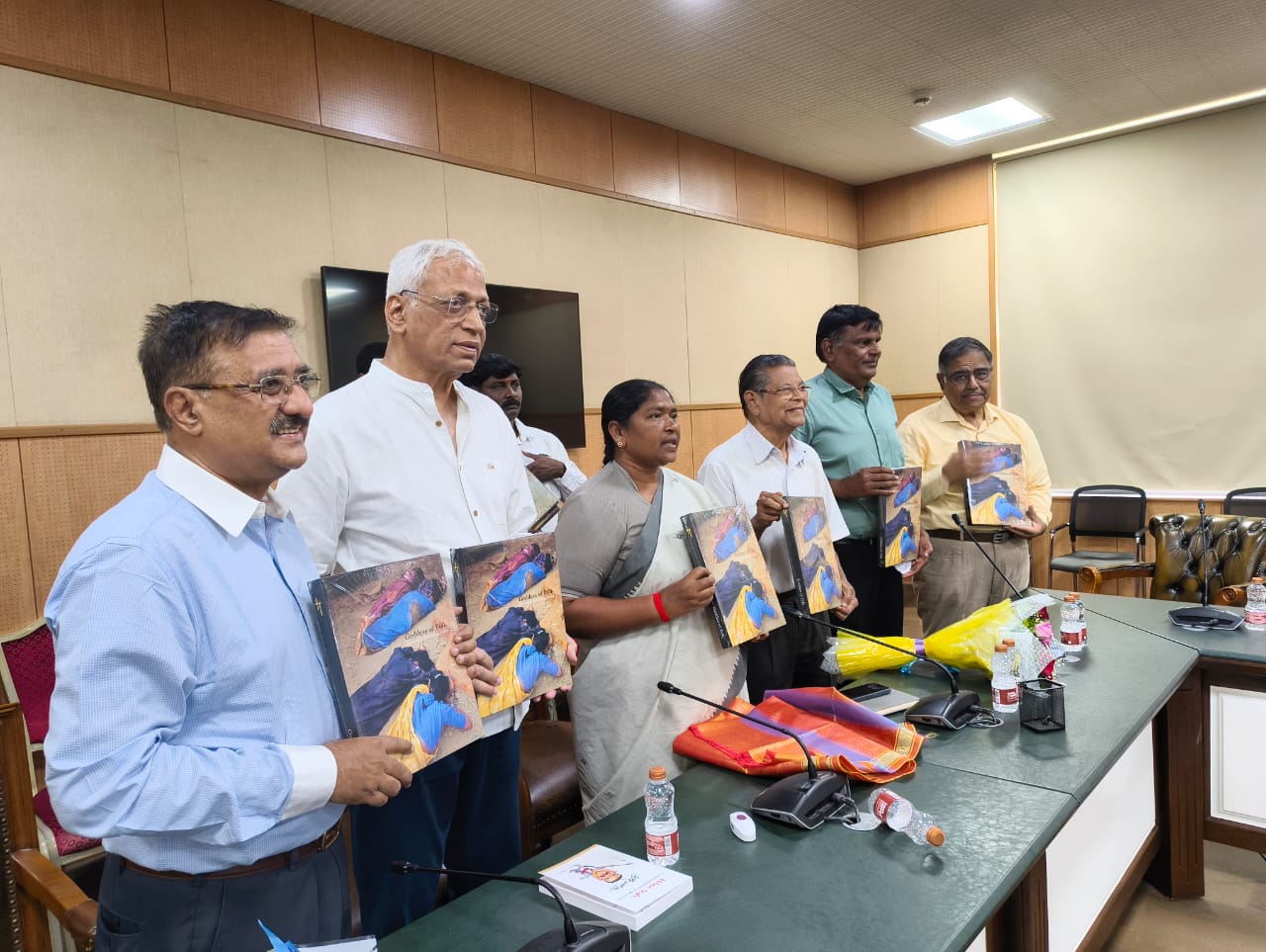

Hyderabad, Feb 20: Telangana Minister for Rural Development Dr. D. Anasuya Seethakka on Thursday released a meticulously compiled coffee table book titled “Goddess of Folk – Sammakka Saralamma Jatara,” published by the Kakatiya Heritage Trust, at Jyoti Rao Phule Praja Bhavan in Hyderabad.
The richly illustrated volume, featuring rare photographs and extensive documentation of the famed Medaram Jatara—popularly known as the Sammakka Saralamma Jatara—has been compiled by noted filmmaker B. Narsing Rao. The launch ceremony was attended by prominent members of the Trust, including retired IAS officers B.P. Acharya and B.V. Papa Rao, retired NIT professor Panduranga Rao, K. Sridhar, and former DGP M. Ratan, among others.
Addressing the gathering, Minister Seethakka lauded the Trust’s commitment to preserving and promoting Telangana’s cultural heritage. She said the publication stands as a significant contribution to documenting the spiritual, historical, and socio-cultural dimensions of one of Asia’s largest tribal congregations. The book, she noted, offers a rare visual and narrative chronicle of the festival, making it an invaluable resource for scholars, cultural enthusiasts, and future generations.
The Minister also urged the Kakatiya Heritage Trust to prepare and submit a comprehensive proposal seeking recognition of the Sammakka Saralamma Jatara as a UNESCO Intangible Cultural Heritage of Humanity. Such recognition, she said, would bring global attention to the festival’s profound cultural and spiritual significance and acknowledge the indigenous traditions it represents.
Held biennially in Medaram, a small forest village in Tadvai mandal of Mulugu district within the Eturnagaram Wildlife Sanctuary, the Sammakka Saralamma Jatara is widely regarded as Asia’s largest tribal religious gathering. Rooted in Koya tribal traditions dating back to around the 13th century, the festival commemorates the legendary warrior goddesses Sammakka and her daughter Saralamma, who, according to folklore, resisted oppressive taxation imposed during the Kakatiya era.
The four-day event transforms the otherwise quiet hamlet—home to fewer than 300 residents—into a vast spiritual center, attracting an estimated 1.5 to 1.75 crore devotees from Telangana, Andhra Pradesh, Odisha, Maharashtra, Madhya Pradesh, and other states. Rituals are conducted exclusively by Koya priests, and devotees offer bellam (jaggery), locally called bangaram, symbolizing gold, as a mark of devotion.
Recognized as an official state festival since 1998, the Jatara has come to symbolize tribal identity, faith, resistance, and unity. Cultural historians believe that formal UNESCO recognition would further strengthen efforts to preserve and promote this living heritage on an international platform.
The newly released coffee table book is expected to play a key role in that effort, serving as both a visual archive and an academic reference that captures the essence, scale, and spiritual depth of this extraordinary folk tradition.