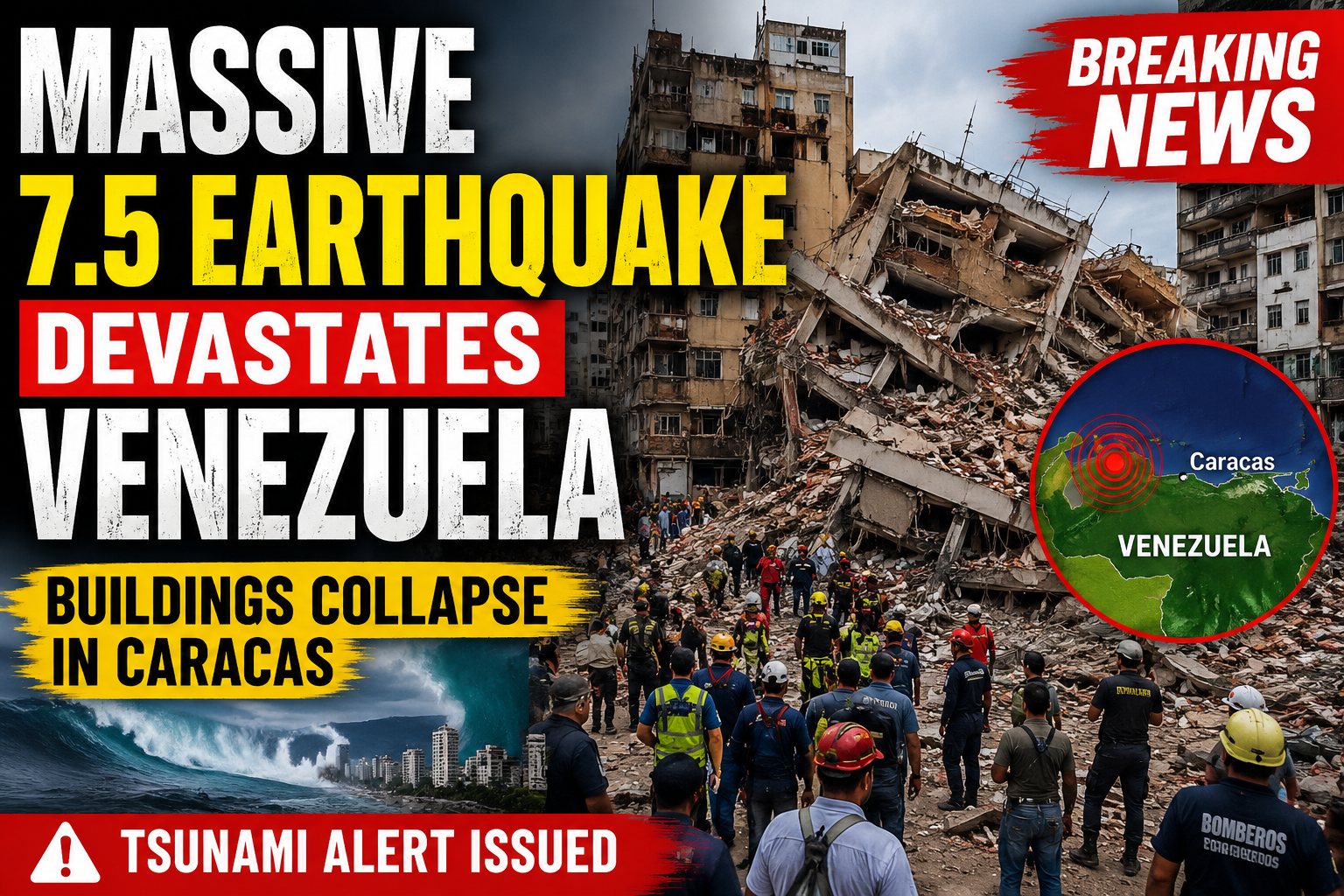

Buildings Collapse in Caracas, Tsunami Alert Issued
7.5 Magnitude Earthquake Hits Venezuela Twice,
Powerful Back-to-Back Earthquakes Devastate Venezuela; Buildings Collapse in Caracas, Tsunami Alerts Triggered
Caracas, June 25, 2026:
Venezuela was struck by a series of powerful earthquakes on Wednesday evening, triggering widespread panic, collapsing buildings in the capital Caracas, disrupting essential services, and prompting tsunami alerts across parts of the Caribbean. Authorities fear the disaster could result in significant casualties and extensive infrastructure damage as search and rescue operations continue through the night.
According to the U.S. Geological Survey (USGS), the first earthquake measured Magnitude 7.1, followed less than a minute later by a stronger Magnitude 7.5 tremor. Both quakes struck at shallow depth near the Caribbean coast, close to the city of Morón, approximately 160–170 kilometres west of Caracas. The shallow nature of the earthquakes significantly amplified ground shaking across northern Venezuela.
The tremors were felt across much of Venezuela and neighboring countries, sending terrified residents rushing into the streets. Multiple residential and commercial buildings suffered severe structural damage in Caracas, with several structures partially or completely collapsing. Roads developed cracks, debris littered major streets, and emergency responders were deployed to rescue people trapped beneath the rubble.
Venezuelan Interior Minister Diosdado Cabello confirmed that several buildings and homes had collapsed in different parts of the capital. Emergency services, firefighters, military personnel, and civil protection teams were mobilized immediately as authorities began large-scale search and rescue operations. Hospitals were placed on emergency alert to receive injured victims.
Power outages affected several districts of Caracas, while telecommunications networks experienced intermittent disruptions. Authorities urged residents to remain outdoors where safe and avoid damaged buildings due to the continuing risk of powerful aftershocks. Schools, government offices, and public transportation services in several affected areas were suspended as engineers began inspecting critical infrastructure.
Following the earthquakes, tsunami advisories and warnings were issued for parts of the Caribbean, including Puerto Rico, the U.S. Virgin Islands, the British Virgin Islands, and islands off Venezuela’s northern coast such as Aruba, Curaçao and Bonaire. Coastal residents were advised to move to higher ground as a precaution. Some warnings were later downgraded or cancelled after further assessment by tsunami monitoring agencies.
Seismologists warned that the earthquake sequence represents one of the strongest seismic events to strike Venezuela in more than a century. The country lies along the complex boundary between the Caribbean Plate and the South American Plate, making northern Venezuela vulnerable to major earthquakes. Experts cautioned that aftershocks could continue for several days, posing additional risks to weakened structures.
Preliminary assessments from the USGS indicated a high probability of severe damage and substantial casualties because the earthquakes occurred at a shallow depth near densely populated urban centres. However, officials stressed that the exact number of fatalities and injuries remained unconfirmed as rescue teams continued searching collapsed buildings.
Eyewitnesses described scenes of chaos as families fled apartment buildings, vehicles stopped abruptly on roads, and emergency sirens echoed across the capital. Many residents compared the disaster to the devastating Caracas earthquake of 1967, with some saying the latest tremors felt even stronger. Thousands spent the night in open spaces, fearing additional aftershocks.
International disaster response agencies and neighboring Caribbean nations are closely monitoring the evolving situation. Humanitarian organizations are preparing emergency assistance should Venezuela request international support.
Authorities have appealed for calm while urging citizens to follow official safety advisories, avoid damaged structures, and remain prepared for further seismic activity. Rescue operations and damage assessments are expected to continue over the coming days as Venezuela confronts one of its most powerful earthquakes in recent history.