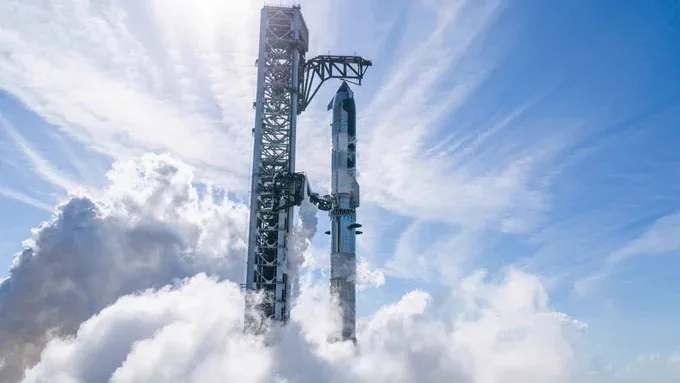
New Delhi, September 28, 2026: SpaceX’s Starship spacecraft reached Earth orbit for the first time on Monday, marking a major milestone in the company’s effort to develop a fully reusable launch system for future missions to the Moon, Mars and beyond. The mission also successfully deployed 26 next-generation Starlink V3 satellites.
The milestone came despite an engine issue during the ascent. One of Starship’s six Raptor Vacuum engines shut down unexpectedly, prompting mission controllers and engineers to assess whether the spacecraft could safely continue its planned orbital mission. After reviewing the vehicle’s performance and remaining engine health, SpaceX proceeded with the orbital attempt.
Starship subsequently performed its orbital insertion manoeuvre and entered Earth orbit for the first time. The mission was the 14th integrated Starship-Super Heavy flight and the first to carry an operational payload into orbit.
26 Starlink V3 Satellites Deployed
A key objective of the mission was the deployment of 26 Starlink V3 satellites. SpaceX confirmed that all 26 satellites were deployed and operating nominally.
The V3 satellites represent a major upgrade to the Starlink constellation. According to the information provided by SpaceX, each satellite is designed to deliver up to 1 terabit per second (Tbps) of downlink capacity and 160 gigabits per second (Gbps) of uplink capacity.
After deployment, the satellites are designed to unfold their antennas and solar arrays and establish communications with ground stations and the wider Starlink network through radio-frequency and laser links. They will subsequently use onboard propulsion to raise themselves toward their operational orbits.
The upgraded satellites incorporate next-generation beamforming technology intended to improve data routing and network capacity. The enhanced system is designed to dynamically allocate capacity according to demand, potentially improving service in both densely populated areas and remote regions.
Starship’s Next Step
The successful orbital flight represents an important test of SpaceX’s long-term objective of developing a rapidly reusable heavy-lift spacecraft. The mission profile was designed to include approximately six orbits of Earth, with the spacecraft originally expected to remain in flight for nearly 10 hours before a controlled splashdown in the Pacific Ocean west of Chile.
The achievement provides SpaceX with a new stage in the development of Starship as a vehicle intended not only for Starlink deployment but also for future deep-space missions.