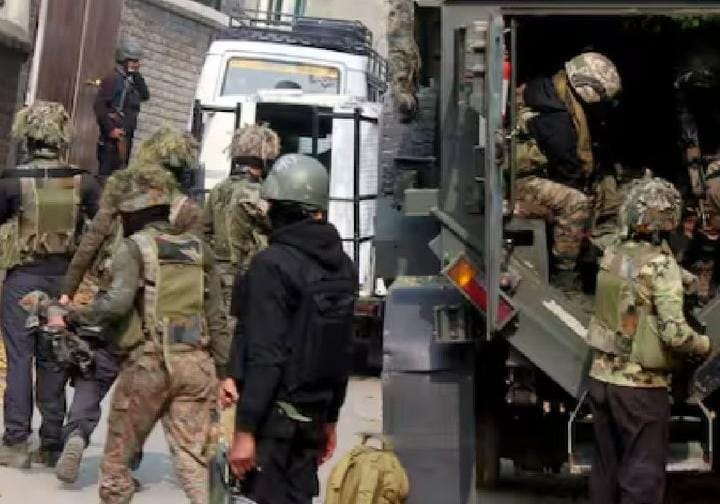

Big Breaking: Indian Army Neutralizes Three Terrorists in “Operation Mahadev” Linked to Pahalgam Massacre
Srinagar, July 28, 2025: In a major counterterrorism success, Indian security forces on Monday neutralized three foreign terrorists believed to be directly involved in the April 22 Pahalgam terror attack. The joint operation, codenamed “Operation Mahadev,” was carried out by the Indian Army’s Chinar Corps in close coordination with the Jammu and Kashmir Police and the Central Reserve Police Force (CRPF). The operation was launched in the Lidwas meadows near the Harwan area, close to Dachigam National Park on the outskirts of Srinagar.
Crackdown Based on Concrete Intelligence
The encounter began in the early hours of July 28 following credible intelligence inputs. Security agencies had intercepted suspicious communications over the weekend, which were further corroborated by inputs from local Gujjar nomads about the presence of armed individuals in the dense Lidwas forest area. Acting swiftly, a joint team from the Indian Army, J&K Police, and CRPF cordoned off the suspected hideout and initiated a combing operation in the general area of Mulnar near Harwan, close to the ecologically sensitive Dachigam Reserve.
The Army confirmed the operation via a post on X (formerly Twitter), stating:
“OP MAHADEV: Contact established in General Area Lidwas. Operation in progress.”
Within hours, an intense firefight broke out, leading to the death of three heavily armed terrorists. Surveillance drones and thermal imaging devices were deployed to monitor the terrain and guide the troops. By midday, the operation had concluded with the neutralization of all three militants.
Link to Lashkar-e-Taiba and Pahalgam Attack
Preliminary intelligence assessments suggest that the terrorists were affiliated with Lashkar-e-Taiba (LeT), a Pakistan-based UN-designated terror group. Security sources also indicate that the operatives may have been part of The Resistance Front (TRF), a LeT proxy outfit that had earlier claimed responsibility for the April 22 Pahalgam attack, which claimed the lives of 26 civilians — including 25 Hindu tourists and one local Kashmiri — in a gruesome shooting in Baisaran Valley, also known as “Mini Switzerland” of Kashmir.
Although forensic identification of the slain militants is underway, initial evidence points to their involvement in the Pahalgam incident, one of the deadliest terror strikes in Jammu and Kashmir since the 2008 Mumbai attacks.
India’s Retaliatory Measures
In response to the Pahalgam massacre, India had launched “Operation Sindoor” in May 2025, targeting terror launchpads and infrastructure in Pakistan and Pakistan-occupied Jammu and Kashmir (PoJK). The precision air and ground operations demonstrated India’s zero-tolerance policy toward cross-border terrorism and its intent to dismantle networks at their source.
Union Home Minister Amit Shah, who visited Srinagar shortly after the April attack, had vowed to ensure justice, stating:
“Those involved in this dastardly act will not be spared. We will deal with them with the full might of the Indian State.”
Prime Minister Narendra Modi had also condemned the Pahalgam attack in the strongest terms, describing it as an “attack on humanity and peace,” and reaffirmed India’s commitment to rooting out terrorism from its soil.
Political and Public Reactions
Reacting to the successful operation, Jammu and Kashmir Chief Minister Omar Abdullah said:
“This is a big relief for the people of Jammu and Kashmir. The neutralization of these terrorists brings some closure to the horrific attack on innocent tourists in April.”
Political leaders from across the spectrum — including the BJP, Congress, and regional parties — have praised the bravery, precision, and coordination shown by the security forces. Social media was abuzz with messages of support and gratitude toward the armed forces, with many users describing the operation as a “befitting reply” to the Pahalgam killings.
Security Preparations for Amarnath Yatra
The timing of Operation Mahadev is also significant, coming just days ahead of the annual Amarnath Yatra, which began on July 3, 2025. Security agencies had been on high alert in anticipation of possible disruption attempts by terrorist groups.
Monday’s encounter sends a strong message that India remains vigilant and proactive in safeguarding pilgrims, civilians, and tourists in the region. Additional troops have been deployed along the Yatra route, and aerial surveillance has been intensified to prevent any further infiltration attempts.
Tourism Impact and Recovery Efforts
The Pahalgam attack dealt a severe blow to Kashmir’s tourism industry, with official figures showing a 50% drop in tourist arrivals in the months following the massacre. Hoteliers, travel agents, and local vendors faced severe economic losses, particularly in the southern districts of the Valley.
Authorities hope that the success of Operation Mahadev will help restore public confidence and encourage the return of tourists to the region. The Jammu and Kashmir Tourism Department is also preparing a recovery campaign aimed at reassuring visitors about the improving security environment.
What’s Next?
The identities and nationalities of the three terrorists are expected to be revealed after DNA profiling and cross-verification with intelligence databases. Sources indicate that several more operatives may still be hiding in the dense forests of Tral, Kupwara, and Poonch, prompting continued combing operations.
Security forces remain on high alert across the Valley, with a renewed focus on intelligence-based operations to prevent future attacks. The success of Operation Mahadev has once again underlined the effectiveness of coordinated security responses and India’s unwavering resolve to protect its people from terrorism.