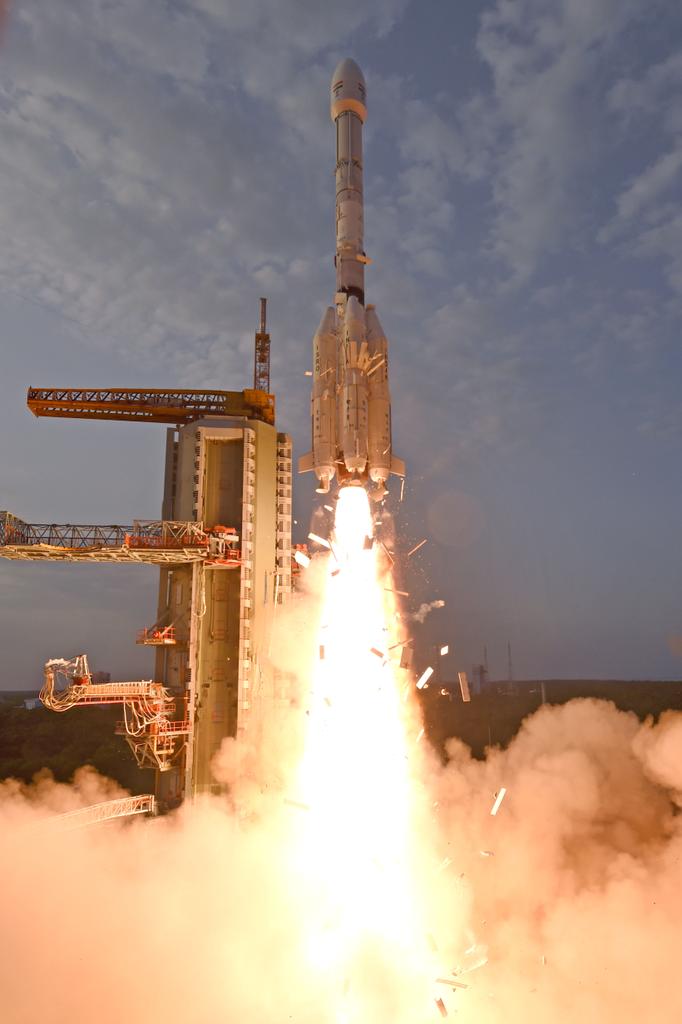

🚀 ISRO Successfully Launches NISAR Satellite into Sun-Synchronous Orbit in Historic Indo-US Collaboration
Sriharikota, July 30, 2025 — In a landmark moment for space collaboration between India and the United States, the Indian Space Research Organisation (ISRO) has successfully launched the NASA-ISRO Synthetic Aperture Radar (NISAR) satellite aboard the GSLV-F16 rocket. The launch was conducted from the Satish Dhawan Space Centre (SDSC) in Sriharikota and marks a significant step forward in Earth observation technology and international cooperation.
Developed jointly by ISRO and NASA’s Jet Propulsion Laboratory (JPL), NISAR has been placed into its designated Sun-Synchronous Polar Orbit with high precision. The satellite is equipped with state-of-the-art dual-frequency radar systems — L-band provided by NASA and S-band by ISRO — making it one of the most advanced Earth-observing satellites ever built.

🌍 Mission Objectives and Capabilities
The primary aim of the NISAR mission is to provide detailed and high-resolution radar imagery of the Earth’s surface, supporting vital research in the fields of:
- Climate change and environmental monitoring
- Tracking glacier movements and ice mass loss
- Monitoring rising sea levels
- Mapping forest biomass and ecosystem health
- Disaster management applications including earthquakes, landslides, and volcanic activity
The satellite will orbit the Earth in a Sun-synchronous orbit, allowing it to capture consistent lighting conditions for precise data comparison over time — crucial for monitoring gradual changes in the planet’s surface.
🤝 A Symbol of Strategic Scientific Partnership
Both ISRO and NASA hailed the mission as a significant achievement in scientific diplomacy and technological cooperation. The successful deployment of NISAR stands as a testament to the growing synergy between India and the United States in the field of space exploration and Earth sciences.
“This mission not only enhances our Earth observation capabilities but also strengthens our global commitment to tackle pressing challenges like climate change and natural disasters,” said a senior ISRO scientist following the launch. NASA officials echoed similar sentiments, emphasizing the mission’s potential to support agriculture, water resources, and urban planning globally.

🔑 Key Highlights of the NISAR Mission:
- Launcher: GSLV-F16
- Orbit: Sun-Synchronous Polar Orbit
- Payload: NISAR (NASA-ISRO Synthetic Aperture Radar) Satellite
- Collaboration: ISRO & NASA Jet Propulsion Laboratory
- Mission Goals: Earth surface deformation monitoring, environmental research, disaster management, and climate modeling

With the successful launch of NISAR, India continues to solidify its role as a major global player in space science and technology. The mission will serve as a critical resource for scientists and policymakers across the globe.
Congratulations to ISRO and NASA JPL on this historic milestone in space collaboration! 🇮🇳🇺🇸
📝 Reported by: Varun Mourya| Updates | India