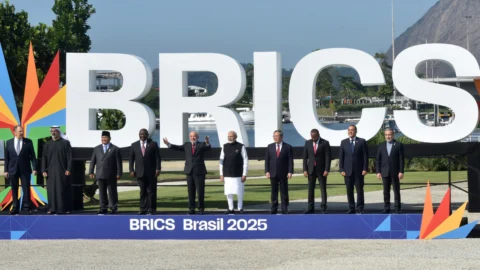

Rio de Janeiro, July 6–7, 2025 — In a landmark move at the 17th BRICS Summit, Brazil, Russia, India, China, and South Africa unveiled substantial progress toward a blockchain-based cross-border payment system—commonly referred to as “BRICS Pay” or the “BRICS Cross-Border Payments Initiative.” The initiative aims to reduce reliance on the US dollar and streamline internal settlements using national currencies and emerging digital tools.

Key Developments from the Summit
- Leaders formally endorsed a technical report from the BRICS Payments Task Force, which proposes enhancing interoperability between national financial systems and outlines pathways for fast, low-cost, transparent, and secure intra-BRICS payments.
- Finance ministers and central bank governors were tasked with advancing these discussions throughout 2025, aiming to present progress at the next BRICS summit in 2026.
- The summit declaration also highlighted BRICS’ broader financial architecture goals—expanding local currency use, building settlement infrastructure like BRICS Clear, reinforcing the Contingent Reserve Arrangement (CRA), and leveraging the New Development Bank (NDB) for local-currency financing and multilateral guarantees.

Pilot Programs and Currency Use
- A pilot scheme between China, India, and Russia has processed over $2 billion in transactions using yuan, rupees, and rubles—particularly for raw materials and industrial goods—demonstrating early-stage real-world testing.
- Projections indicate a 15–20% increase in intra-BRICS trade using national currencies during 2025–2026, signaling early momentum for de-dollarization efforts.
Digital Innovation & Cost Savings
- The technical blueprint draws inspiration from India’s UPI system, noted for transaction costs around 0.1%, compared to the 2.5% typical of dollar-based international transfers. Brazil’s Pix system, with similar efficiency, processed approximately $1.4 trillion in 2024 at roughly 0.2% per transaction. Extending such efficiencies across BRICS could save the bloc up to $120 billion annually by 2030.
- Additionally, China’s digital yuan pilot has processed $87 billion in digital transactions across 35 cities—with cross-border trials involving Russia and South Africa contributing to groundwork for broader integration.
Challenges and Persistent Realities
- Analysts remain cautious, noting that previous efforts like “BRICS Bridge” unveiled at the 2024 Kazan Summit met limited enthusiasm and political backing, especially amid US sanctions and geopolitical sensitivity.
- Tensions between lofty ambitions and practical execution persist, with deep economic ties to Western infrastructure and concerns about governance, trade imbalances, and differing regulatory frameworks.
Outlook

If mastering its ambitious pilot phase, BRICS could gradually chip away at the dollar’s global dominance—especially in emerging economies—though full rollout may extend beyond 2026. Upcoming leadership under India in 2026 will be pivotal in determining whether the bloc can transition from diplomatic declarations to functional transformation.