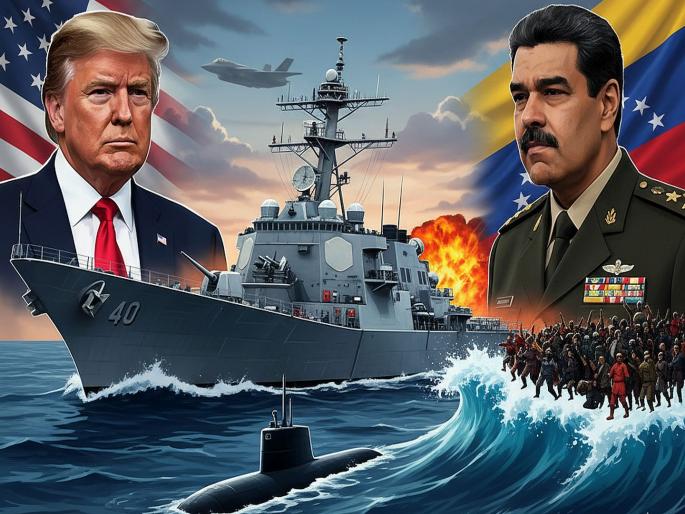

US Launches Major Strike on Venezuela, Captures President Nicolás Maduro in Dramatic Operation
Washington, D.C., January 4, 2026
In a dramatic and unprecedented escalation of tensions between Washington and Caracas, the United States has carried out a large-scale military operation in Venezuela, resulting in the capture of Venezuelan President Nicolás Maduro and his wife, Cilia Flores. The operation was announced early Saturday by US President Donald J. Trump, who described it as a coordinated mission involving the US military and federal law-enforcement agencies.
Posting on his social media platform Truth Social, Trump said the raid successfully neutralised Venezuela’s top leadership and that Maduro and Flores had been “flown out of the country.” He said further details would be released at a news conference scheduled for later in the day at his Mar-a-Lago residence in Florida.
“This operation was conducted in conjunction with US law enforcement. Details to follow,” Trump wrote, calling the mission a decisive strike against what he termed a “narco-terrorist regime.”
Maduro flown to US, faces serious charges
The White House later released an image purportedly showing a blindfolded and handcuffed Maduro aboard the USS Iwo Jima, with US officials stating that he was being transported to New York to face federal charges. According to the US Justice Department, the charges include narco-terrorism conspiracy, large-scale cocaine trafficking, and illegal possession of machine guns and other destructive devices.
US Attorney General Pam Bondi confirmed the indictments, praising the execution of the mission and describing it as a landmark moment in the US fight against international drug trafficking.
“They will soon face the full weight of American justice on American soil,” Bondi said in a statement.
Caracas rocked by explosions, emergency declared
In Venezuela, the operation triggered chaos and anger. Explosions were reported overnight in several parts of Caracas, with state media claiming US forces struck military installations, infrastructure facilities and nearby civilian areas. Power disruptions and communications outages were reported in parts of the capital.
Venezuelan Defence Minister Vladimir Padrino López, speaking from what he described as a secure location, denounced the action as “criminal imperialist aggression” and vowed armed resistance.
“The Venezuelan people have become the target of the most serious military aggression by the government of the United States,” he said, announcing a massive deployment of the Bolivarian National Armed Forces and urging citizens to unite in defence of national sovereignty.
Vice President Delcy Rodríguez, who is expected to assume interim authority, addressed the nation and declared a state of emergency. She demanded proof of life for Maduro and Flores and accused Washington of violating international law.
“We do not know President Maduro’s whereabouts. This is a kidnapping of a head of state,” Rodríguez said.

Years of tensions boil over
The operation follows years of deteriorating relations between the two countries. The US has long accused Maduro’s government of electoral fraud, human-rights abuses and links to international drug cartels. Tensions intensified throughout 2025 during Trump’s second term, as Washington expanded sanctions and deployed additional naval assets to the Caribbean under counter-narcotics operations.
In August 2025, Trump signed a directive authorising military action against Latin American drug cartels, a move widely seen as laying the groundwork for direct action against Venezuela. In December, he warned Maduro against “playing tough” and made controversial remarks about Venezuelan oil assets, asserting that the US could seize or manage them amid the country’s economic collapse.
Global backlash and regional unease
International reaction was swift and sharply divided. Russia, China, Cuba and Iran condemned the strike as a blatant violation of Venezuelan sovereignty. Chinese state media described the operation as a “revival of the Monroe Doctrine” and accused Washington of seeking regional domination.
The United Nations has not issued an official statement, though several member states have reportedly called for an emergency meeting of the Security Council. In Latin America, responses ranged from cautious calls for stability from countries such as Brazil and Colombia to outright condemnation from left-leaning governments.
Uncertain road ahead
Domestically, Trump hailed the operation as a major victory against global drug networks, telling reporters he followed the mission “like a TV show” and suggesting that the US may temporarily oversee Venezuela to ensure what he called a “safe and orderly transition.” He also indicated that American energy companies could play a role in managing Venezuela’s vast oil reserves.
Critics in the US, including opposition lawmakers, questioned the constitutionality of the action and warned it could plunge the region into prolonged instability. Former US envoy to Venezuela Elliott Abrams cautioned that many Venezuelans would strongly oppose any form of US control, predicting widespread unrest.
As details continue to emerge from Washington, the capture of Nicolás Maduro marks a turning point in hemispheric politics, with the potential to reshape Latin America’s geopolitical landscape while raising the risk of a broader and more prolonged conflict.