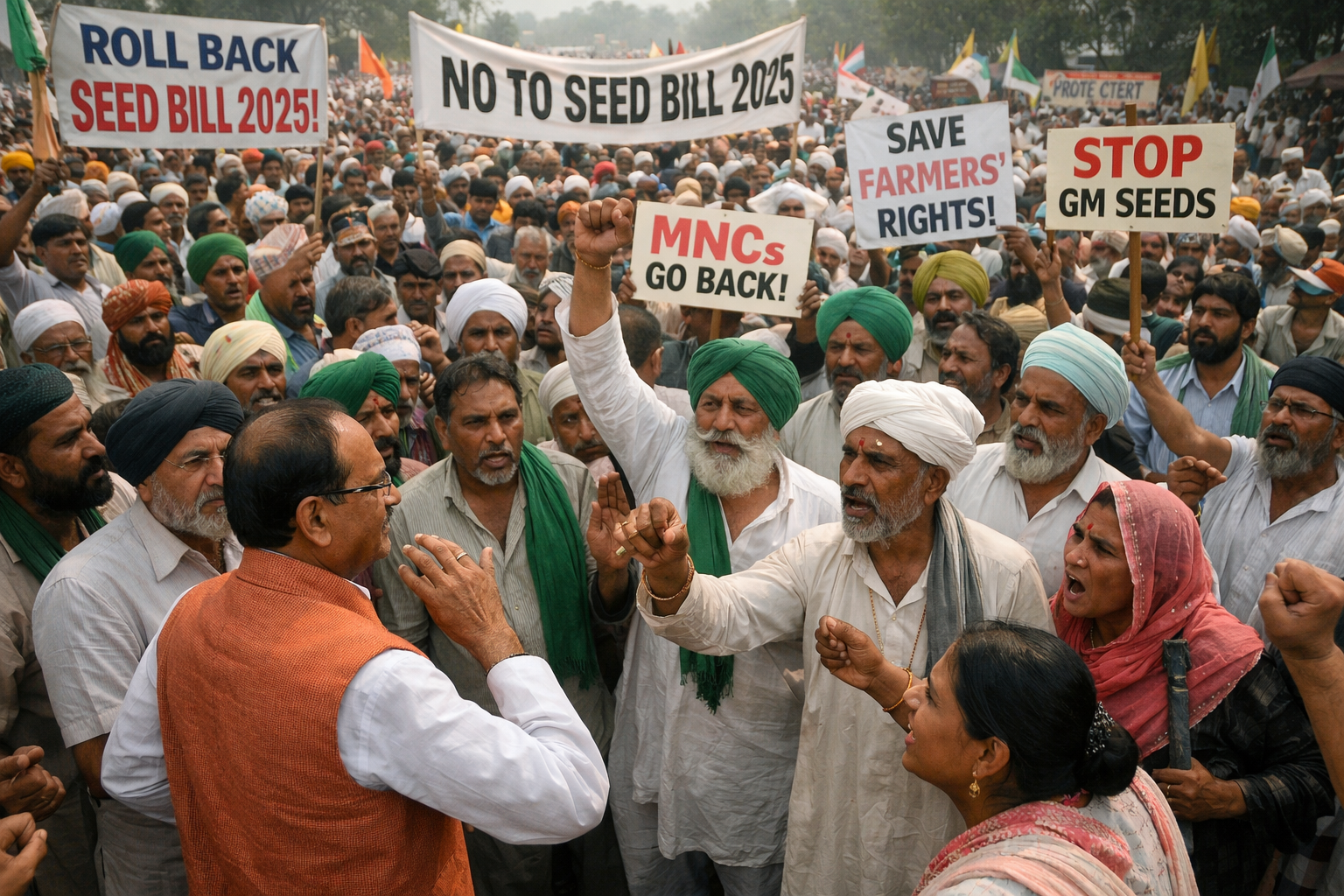

Farmers Raise 10 Key Questions to Union Agriculture Minister Over Seed Bill 2025
New Delhi: Protests against the proposed Seed Bill 2025 are intensifying across the country, with several farmers’ organisations raising serious concerns about the provisions of the Bill. Addressing Union Minister for Agriculture & Farmers’ Welfare Shri Shivraj Singh Chouhan, farmer groups have posed ten critical questions, alleging that the proposed legislation favours multinational and large domestic seed corporations over small and marginal farmers.
Farmers argue that the government’s claim that the Seed Bill 2025 protects Indian agriculture is misleading. They contend that the Bill appears heavily biased toward corporate interests, triggering widespread protests in multiple states.
Centralization vs. State Powers
One of the primary concerns relates to federal structure. Agriculture is constitutionally a state subject, yet the Union Government has introduced the Bill allegedly without adequate consultation with state governments. The proposed legislation seeks to establish a Central Seed Committee with sweeping powers over seed production, testing, certification, and distribution. Farmer leaders argue that such centralization undermines the autonomy of states and excludes adequate state representation in decision-making processes.
Quality, Affordability, and Access
Farmers have questioned why the Bill does not explicitly guarantee the supply of quality seeds at affordable prices and on time. They say that ensuring seed availability should be the foremost objective of any farmer-centric legislation. However, according to them, the Bill remains silent on price regulation and affordability safeguards.
Alleged Violation of Farmers’ Rights
Another major concern raised is the alleged conflict with the Protection of Plant Varieties and Farmers’ Rights (PPVFR) Act, 2001, which grants farmers the right to produce, save, exchange, and sell farm-saved seeds. Farmer organisations claim the new Bill puts small traditional seed producers on par with corporate companies by mandating registration requirements, thereby placing an administrative burden on small farmers and undermining their traditional rights.
Foreign and GM Seeds Debate
Farmers have also objected to provisions allowing the entry of foreign-tested seeds into India. They point out that India has 15 distinct agro-climatic zones with diverse soil and monsoon patterns. According to protestors, foreign-tested or genetically modified (GM) seeds could threaten indigenous seed varieties and compromise seed sovereignty. They have questioned why there is no explicit ban on GM seeds in the absence of nationwide consensus.
Regulatory and Pricing Concerns
The Bill has also been criticised for allegedly easing the entry of multinational corporations (MNCs) into India’s seed market. Farmer groups allege that certain provisions could bypass regulatory oversight bodies and weaken earlier safeguards under the Seeds Act of 1966 and Seeds Rules of 1983, which included restrictions on imports and measures against black marketing.
In addition, farmers have expressed concern over rising seed prices, especially for vegetable and hybrid varieties. They argue that the Bill lacks mechanisms to regulate seed pricing or prevent profiteering.
Public Research and Cooperatives
Farmers have further questioned why the proposed legislation does not adequately promote public research institutions such as the Indian Council of Agricultural Research (ICAR), seed villages, and farmer cooperatives. They argue that strengthening public sector research and cooperative seed production could ensure affordable, high-quality seeds for small farmers.
Compensation and Legal Remedies
Compensation for crop failure due to spurious or substandard seeds is another contentious issue. Farmer leaders have demanded that the Bill mandate accessible compensation mechanisms covering cultivation costs, lost profits, and fresh seed purchases. They also seek stricter legal action against companies responsible for supplying defective seeds. Criticism has also been directed at provisions that reportedly restrict farmers’ ability to directly file complaints regarding crop loss.
Digital Mandates and Ground Realities
The requirement for QR codes on seed packets has also drawn criticism. Farmers argue that many small producers in rural areas have limited internet access and digital literacy, making such mandates impractical and exclusionary.
Demand to Reconsider
Concluding their statement, farmer organisations warned that unless satisfactory answers are provided, they would strongly demand that the government refrain from enacting the Seed Bill 2025 in Parliament. They maintain that the legislation, in its current form, risks compromising India’s seed sovereignty and placing the country’s agricultural future in the hands of large multinational corporations.
The government has yet to issue a detailed response to the concerns raised by farmer groups.