
“Aditya-L1 Mission Update: Satellite in Optimal Health After Successful Earth-bound Maneuver
Bengaluru, India – In a remarkable achievement, the Aditya-L1 satellite has continued its journey toward the sun, demonstrating perfect health and functionality. The first Earth-bound maneuver (EBN#1) was executed flawlessly from the Indian Space Research Organisation’s Telemetry, Tracking and Command Network (ISTRAC) in Bengaluru.
The satellite has now reached a new orbit with dimensions of 245km x 22,459km. This achievement marks a significant milestone in India’s ambitious mission to study the Sun and its activities.
Looking ahead, the Aditya-L1 mission is gearing up for its next maneuver (EBN#2), which is scheduled for September 5, 2023, at approximately 03:00 Hrs. IST. The mission continues to progress smoothly, bringing us closer to unlocking the mysteries of our solar system’s central star.”

India’s PSLV Successfully Launches Aditya-L1 Spacecraft to Study the Sun
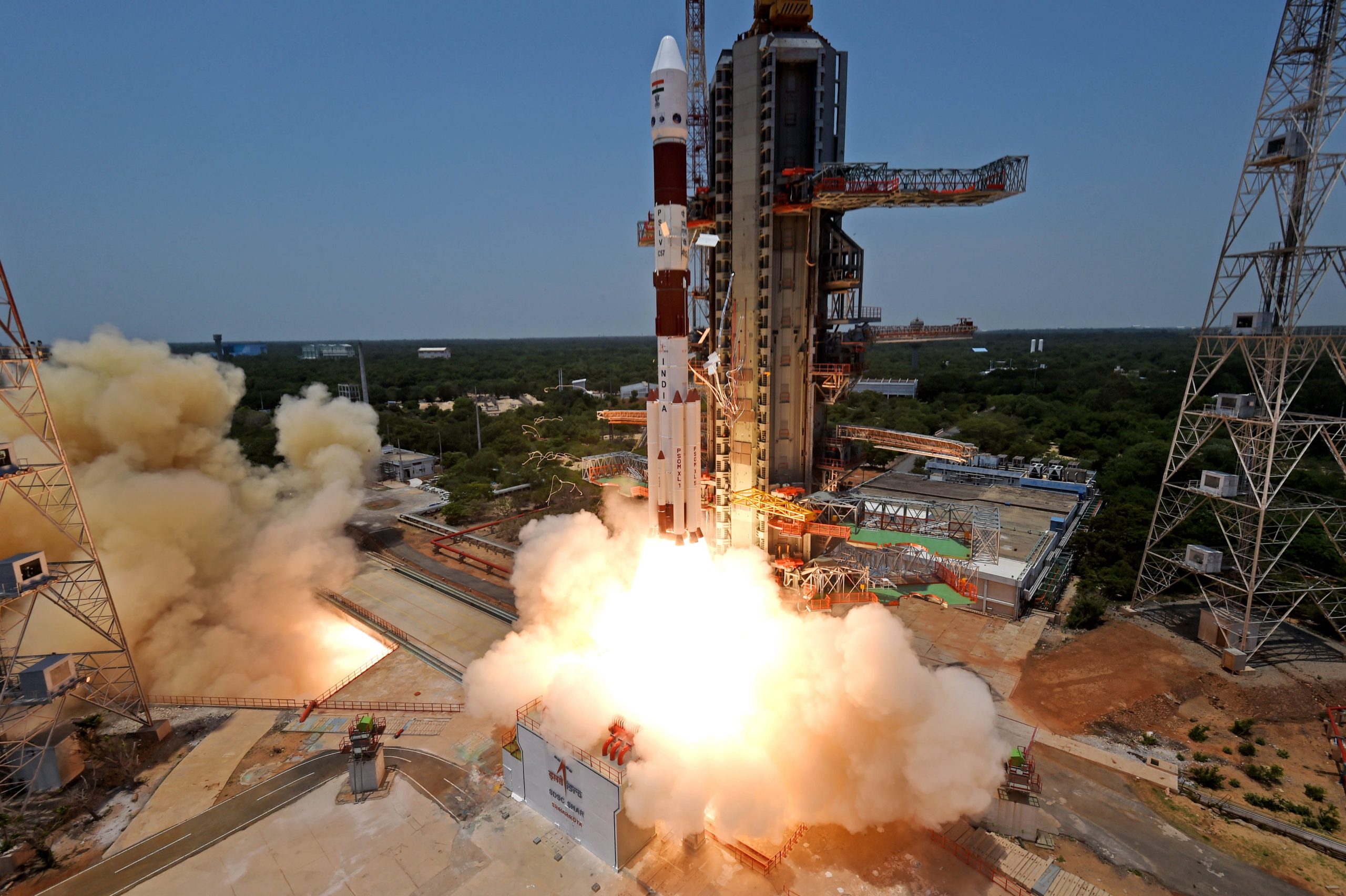
In a flawless launch, India’s Polar Satellite Launch Vehicle (PSLV) successfully placed the Aditya-L1 spacecraft into orbit on a recent Saturday afternoon. Named after the Sun God in Hindu mythology, Aditya-L1 now embarks on a four-month journey to its intended slot for studying the Sun, approximately 1.5 million kilometers away.

The 44.4-meter-tall PSLV-C57, with a lift-off weight of 321 tons, roared into the sky from the Satish Dhawan Space Centre. Spectators watched in awe as the rocket ascended, propelled by a thick orange flame and the sound of thunder, leaving behind a plume of smoke.
This mission marked one of the longest for both the rocket and the Indian Space Research Organisation (ISRO). Approximately 63 minutes after liftoff, the rocket released Aditya-L1, concluding the mission about 73 minutes after the fourth stage was deactivated.

Dr. S. Unnikrishnan, Director of the Vikram Sarabhai Space Centre (VSSC), explained the mission’s extended duration, citing the need to meet the argument of perigee of the satellite. This involved two burn strategies for the fourth stage, with a prolonged coasting phase after the first burn.


Aditya-L1 initially entered a low Earth orbit (LEO), and as it travels toward the Lagrange Point (L1), it will exit Earth’s gravitational Sphere of Influence (SOI). Once beyond the SOI, the cruise phase begins, leading to the injection of the spacecraft into a large halo orbit around L1, where the gravitational pulls of the Sun and Earth are balanced, preventing the spacecraft from gravitating toward either body.
This journey from launch to L1 will span approximately four months, covering a distance of about 1.5 million kilometers from Earth. To put this in perspective, the distance between Earth and the Moon is about 384,000 kilometers.


Aditya-L1’s unique orbit around L1 offers continuous, unobstructed views of the Sun, making it ideal for observing solar activities and their impact on space weather in real-time, according to ISRO.
The PSLV, in its standard configuration, is a four-stage/engine expendable rocket, utilizing solid and liquid fuels interchangeably and equipped with six booster motors on the first stage for increased thrust during liftoff.
Interestingly, the XL variant of the rocket used for this mission had previously been employed for India’s Chandrayaan-1 (Moon Mission-1), Chandrayaan-2, and Mars Mission/Mars Orbiter Mission. This launch marked the XL variant’s 25th flight in support of an interplanetary mission.
This launch follows India’s successful lunar landing on August 23, with its lander safely touching down on the lunar surface, followed by the deployment of a rover for experiments.


Aditya-L1 carries seven payloads designed to observe the Sun’s photosphere, chromosphere, and outermost layers (the corona) using electromagnetic and particle detectors, as well as magnetic field detectors. These instruments will provide critical data to better understand solar dynamics, coronal heating, coronal mass ejections, space weather, particle and field propagation, and more.
ISRO outlined the primary science objectives of the Aditya-L1 mission, including studying solar upper atmospheric dynamics, chromospheric and coronal heating, partially ionized plasma physics, coronal mass ejections, and flares. The mission will also observe the in-situ particle and plasma environment to study particle dynamics originating from the Sun.
Additionally, the mission aims to investigate the physics of solar corona, its heating mechanism, the diagnostics of plasma in coronal loops, magnetic field topology in the solar corona, and the drivers for space weather, such as solar wind composition and dynamics.
The Sun, estimated to be 4.5 billion years old, is a hot ball of hydrogen and helium gases that serves as the primary energy source for the solar system. It plays a crucial role in holding the solar system together through its gravity.
Studying the Sun in detail provides insights not only into our own star but also into other stars within our Milky Way and other galaxies. The Sun’s dynamic behavior, including eruptive phenomena and the release of vast amounts of energy, can impact Earth’s near-space environment, affecting spacecraft, communication systems, and even astronauts.


ISRO emphasized that all seven payloads aboard Aditya-L1 were developed domestically by various Indian laboratories in close collaboration with the space agency. These payloads cover a range of scientific instruments, including the Visible Emission Line Coronagraph (VELC), Solar Ultraviolet Imaging Telescope (SUIT), Aditya Solar wind Particle Experiment (ASPEX), Plasma Analyser Package for Aditya (PAPA), Solar Low Energy X-ray Spectrometer (SoLEXS), High Energy L1 Orbiting X-ray Spectrometer (HEL1OS), and the Magnetometer.
The successful launch of Aditya-L1 marks another significant milestone for India’s space exploration efforts and its commitment to advancing our understanding of the Sun and its impact on our solar system.