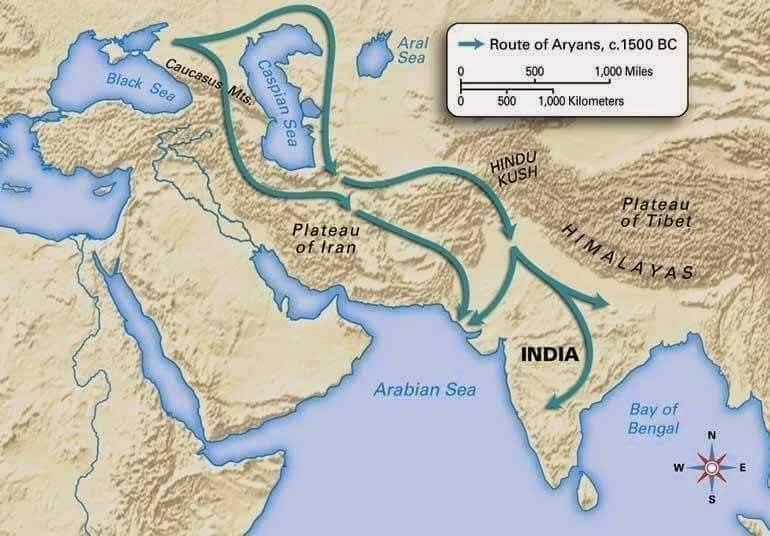

Unveiling the Aryan Migration: Myths and Scientific Facts Before the Indus Valley Civilization
Varun Mourya
The question of the Aryan migration to India remains one of the most debated topics in Indian history. The period before the Indus Valley Civilization has sparked numerous theories, myths, and scientific discussions regarding the arrival of the Aryans. This article delves into the misconceptions and realities surrounding the Aryan migration, grounded in historical evidence, scientific research, and social analysis.
Aryan Migration Theory: Myths vs. Facts
The notion that Aryans migrated to India from regions like the Arctic or the Volga River basin has been widely discussed. Bal Gangadhar Tilak, in his book The Arctic Home in the Vedas, proposed that Aryans originated from the Arctic region. Rahul Sankrityayan, in From Volga to Ganga, suggested their roots lay in the Volga River region. Jawaharlal Nehru, in The Discovery of India, described Aryans as foreigners who migrated to India. However, critics argue these claims rely heavily on speculation rather than scientific evidence.
Dr. B.R. Ambedkar, in his seminal work Who Were the Shudras?, critically examined the Aryan migration theory, dismissing it as a Western construct lacking scientific backing. He rejected the “Aryan conquest theory,” which posited that Aryans subjugated indigenous populations, warning that its acceptance by Brahmins could perpetuate the marginalization of oppressed communities. Similarly, Jyotirao Phule, in his book Gulamgiri, challenged Brahminical hegemony, exposing its reliance on the Aryan narrative to assert dominance.
Scientific Evidence: DNA Research
A significant breakthrough came in a 2001 article published by The Times of India (December 21), citing research by Michael Bamshad from the University of Utah. Using DNA technology, Bamshad demonstrated that Brahmins (often equated with Aryans) were not of Indian origin but had foreign ancestry. Intriguingly, the study revealed that Brahmin women were of Indian descent, suggesting that Aryan men, during their migration, married local women rather than bringing women with them. To safeguard their lineage and secrets, practices like sati (widow immolation) were institutionalized, a custom predominantly observed among Brahmins.
The Indus Valley Civilization: Pre-Aryan Era
Scientific evidence confirms that a highly advanced civilization thrived in the Indus Valley, encompassing cities like Harappa and Mohenjo-Daro, long before the Aryan migration. These urban centers boasted sophisticated culture, trade, and urban planning. Archaeological findings indicate that the Aryan migration occurred during the declining phase of this civilization. Scholars believe Aryans entered India in phases, gradually integrating with local cultures rather than conquering them outright, as suggested by the now-discredited conquest theory.
Social Implications: Resistance to Brahminical Dominance
The Aryan migration theory has often been used to justify Brahminical supremacy, prompting resistance from social reformers. Jyotirao Phule, Ambedkar, Periyar Ramaswamy, and Kanshi Ram led movements to counter this narrative. Periyar’s Dravidian movement in South India rejected the Aryan theory, fostering a sense of regional identity. Kanshi Ram’s Bahujan ideology empowered marginalized communities, challenging Brahminical narratives. These movements instilled fear among Brahmins, some of whom began labeling the Aryan theory as a British conspiracy to obscure their historical dominance.
Truth Lies in Scientific Evidence
As the Buddha advised, truth must be discerned through reason and evidence, not blind faith or tradition. DNA research and archaeological findings have shed light on the Aryan migration, positioning it as a historical event rather than a myth of conquest. However, its use as a tool for social domination has deepened inequalities, fueling debates that persist today.
Conclusion
Before the Aryans set foot in India, the Indus Valley Civilization flourished as a beacon of human achievement. While the Aryan migration is a historical reality, its manipulation to uphold caste hierarchies has had lasting social repercussions. By grounding our understanding in scientific evidence and critical reasoning, we can dispel myths and uncover the truth. As the Buddha said, “Do not accept something as true merely because it is said by the wise or believed by the faithful. Verify it through your own reasoning.” This principle remains the cornerstone of unraveling the complex history of the Aryan migration.