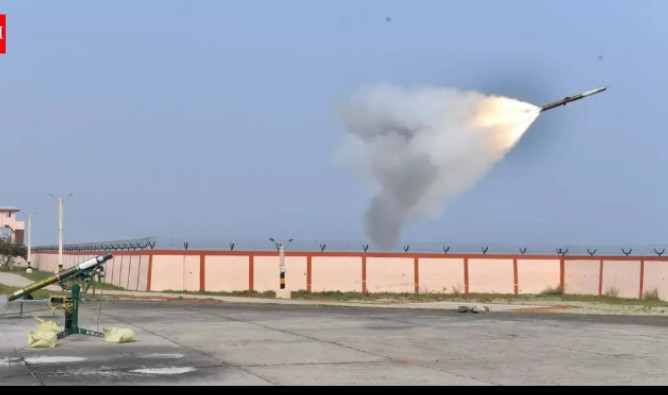

DRDO Advances Shoulder-Launched Version of Indigenous VSHORADS Missile System
Hyderabad/New Delhi: The Defence Research and Development Organisation (DRDO) is moving ahead with the development of a shoulder-launched version of its indigenous Very Short Range Air Defence System (VSHORADS), marking a significant step toward strengthening India’s short-range air defence capabilities.
After successfully validating the tripod-mounted configuration of the system, DRDO scientists are now working on transforming the missile system into a fully man-portable, shoulder-fired weapon that can be easily operated by infantry soldiers in battlefield conditions.

Defence sources said that the Research Centre Imarat (RCI) in Hyderabad, the lead laboratory responsible for the VSHORADS project, is currently focusing on miniaturizing and reducing the weight of the system. The proposed shoulder-launched variant is expected to weigh around 15 to 18 kilograms, placing it in the category of globally recognised Man-Portable Air Defence Systems (MANPADS).
The lightweight configuration is designed to enable soldiers to quickly deploy the weapon in combat zones and neutralize low-altitude aerial threats such as drones, helicopters, and slow-moving aircraft.
Strong Operational Capabilities
Despite the reduction in size and weight, the shoulder-fired VSHORADS is expected to retain strong operational capabilities. Defence officials indicated that the missile will have an effective range of approximately 6 kilometres and the ability to engage targets at altitudes of up to 3.5 kilometres.

These features will make the system particularly useful for frontline infantry units and air defence teams deployed in difficult terrains such as mountains, deserts, and border regions.
Successful Trials of Tripod Variant
The development of the shoulder-launched version follows the successful testing of the tripod-mounted VSHORADS system. The missile recently completed three consecutive successful flight trials in February 2026 at the Integrated Test Range (ITR) in Chandipur, Odisha.
During these trials, the missile demonstrated its hit-to-kill capability, accurately intercepting high-speed aerial targets designed to simulate enemy aircraft. The tests validated the system’s performance across different parameters, including range, altitude, and target speed.
With most developmental trials completed, the tripod variant is currently undergoing user validation trials by the armed forces, bringing it closer to operational induction.
Advanced Technology and Indigenous Development
The indigenous VSHORADS program represents a fourth-generation MANPADS developed under India’s Atmanirbhar Bharat initiative, aimed at reducing dependence on foreign defence imports.
One of the key technological features of the system is its uncooled Imaging Infrared (IIR) seeker, which enables accurate target tracking without the need for coolant gas cylinders used in older missile systems. This makes the system simpler, more reliable, and easier to maintain in field conditions.

Competing with Global Systems
Once fully operational, India’s shoulder-launched VSHORADS is expected to stand alongside some of the world’s leading portable air defence systems, including the American FIM-92 Stinger, Russia’s Igla-S, and Verba missiles.
The system will play an important role in strengthening India’s layered air defence architecture, particularly by providing last-line protection to ground forces against low-flying aerial threats.
Defence analysts believe that the successful development of VSHORADS will significantly enhance the combat capability of the Indian Army, Air Force, and Navy, while also reinforcing India’s growing self-reliance in advanced defence technologies.