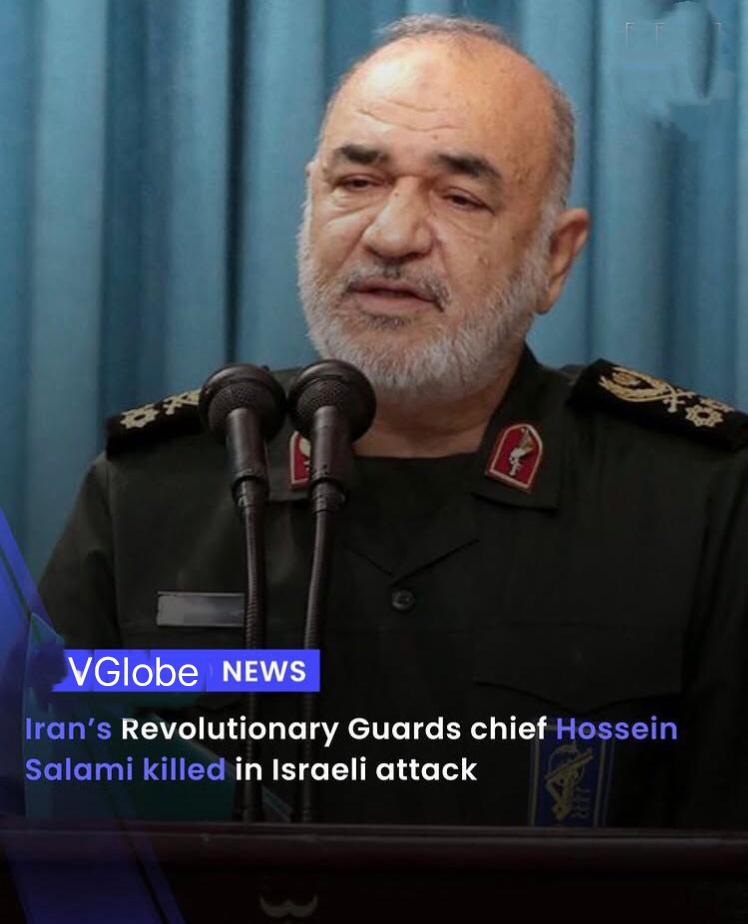

Israeli Airstrike Kills IRGC Commander and Top Iranian Officials in Tehran, Escalating Middle East Tensions
Tehran, Iran – June 13, 2025: In a dramatic escalation of hostilities, Iran has confirmed the death of Major General Hossein Salami, commander of the Islamic Revolutionary Guard Corps (IRGC), in an Israeli airstrike targeting the IRGC headquarters in Tehran. The strike, part of Israel’s “Operation Rising Lion,” is also believed to have killed Iran’s military chief, General Mohammad Bagheri, and several top nuclear scientists. Israeli Prime Minister Benjamin Netanyahu described the operation as a preemptive strike to neutralize Iran’s nuclear and missile programs, which he labeled an “existential threat” to Israel.
The airstrike, conducted in the early hours of Friday, razed a heavily fortified section of the IRGC headquarters, causing significant casualties and structural damage. Iranian state media reported at least 15 fatalities, though the exact toll remains unconfirmed. Supreme Leader Ayatollah Ali Khamenei condemned the attack as “a cowardly act of aggression” and vowed a “severe response,” raising fears of a broader regional conflict.
Details of “Operation Rising Lion”
According to Israeli military sources, “Operation Rising Lion” was a meticulously planned operation involving advanced intelligence and precision-guided munitions. The strike targeted key figures in Iran’s military and nuclear establishment, aiming to disrupt the country’s ballistic missile development and alleged nuclear weapons program. Netanyahu, in a televised address, stated, “Israel will not allow Iran to acquire nuclear capabilities or threaten our existence. Today, we acted decisively to protect our people and our future.”
The operation has drawn international attention due to its high-profile targets. Major General Hossein Salami, a hardline figure who led the IRGC since 2019, was a central architect of Iran’s regional military strategy, including its support for proxy groups like Hezbollah and Hamas. General Mohammad Bagheri, as Chief of Staff of the Armed Forces, oversaw Iran’s broader military operations. The loss of these leaders, alongside nuclear scientists reportedly linked to Iran’s secretive Natanz facility, represents a significant blow to Tehran’s military and scientific capabilities.
Global Reactions and Regional Fallout
The international community is bracing for the repercussions of this unprecedented escalation. The United States, Israel’s closest ally, issued a cautious statement urging “all parties to exercise restraint” while reaffirming its commitment to Israel’s security. U.S. Secretary of State Antony Blinken is reportedly engaging in urgent diplomatic talks to prevent further violence.
Russia and China, key allies of Iran, condemned the airstrike. Russian Foreign Minister Sergey Lavrov called it “a reckless violation of international law,” while China’s Foreign Ministry urged an immediate ceasefire and dialogue. Meanwhile, Saudi Arabia and other Gulf states, wary of Iran’s regional influence, have remained notably silent, reflecting the complex dynamics of Middle Eastern geopolitics.
In Lebanon, Hezbollah, an IRGC-backed militant group, declared a state of “maximum alert” and vowed retaliation, raising concerns about a multi-front conflict. Missile exchanges between Israel and Hezbollah have intensified along the Israel-Lebanon border, with at least three Israeli soldiers and seven Lebanese civilians reported killed in the past 24 hours.
Economic and Humanitarian Impact
The escalation has sent shockwaves through global markets. Oil prices surged by 8% as traders feared disruptions to Middle Eastern energy supplies, with Brent crude reaching $92 per barrel. Iran, a major OPEC producer, has threatened to close the Strait of Hormuz, a critical chokepoint for global oil shipments, in response to further aggression.
In Tehran, the airstrike has sparked widespread anger and grief. Thousands gathered outside the IRGC headquarters, chanting anti-Israel and anti-U.S. slogans. Iranian authorities have declared three days of national mourning for Salami and other victims. Humanitarian organizations are warning of a potential refugee crisis if the conflict spreads, with millions already displaced by regional wars in Syria and Yemen.
What Lies Ahead?
Analysts warn that the assassination of such high-ranking figures could push Iran to accelerate its nuclear program or launch retaliatory strikes, potentially targeting Israeli cities or U.S. bases in the region. The United Nations Security Council is set to hold an emergency meeting later today to address the crisis, though deep divisions among permanent members are likely to hinder any unified response.
As the Middle East teeters on the brink of a wider war, the world watches anxiously. The killing of Hossein Salami and other Iranian officials marks a dangerous turning point, with the potential to reshape the region’s security landscape for years to come.