
U.S. Launches Precision Strikes on Iran’s Nuclear Facilities, Trump Hails “Historic Victory”
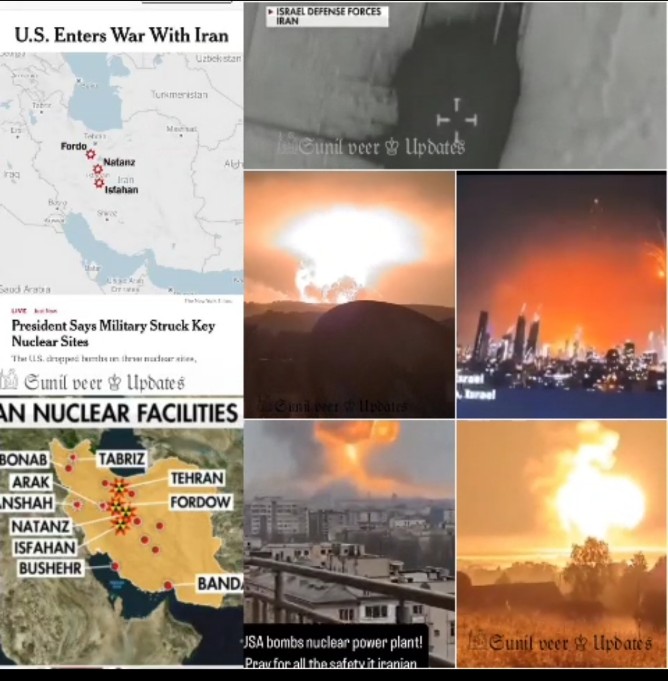
Washington, D.C. — In a dramatic escalation of tensions in the Middle East, President Donald Trump announced on June 22, 2025, that the United States had successfully conducted targeted airstrikes on three of Iran’s key nuclear facilities: Fordow, Natanz, and Isfahan. The operation, executed in the early hours of June 21-22, involved a formidable display of U.S. military might, with six B-2 Spirit stealth bombers deploying massive GBU-57 bunker-busting bombs on the heavily fortified Fordow site and 30 Tomahawk cruise missiles striking the Natanz and Isfahan nuclear complexes.

https://x.com/i/broadcasts/1DXxyqpYydkxM?t=wVL7Im1U2wWqw78N6Nfrpw&s=08
In a statement posted on Truth Social, President Trump described the strikes as a “historic moment” for global security, declaring that the operation had dealt a significant blow to Iran’s nuclear ambitions. “Our brave pilots and crews executed a flawless mission, and all aircraft returned safely after exiting Iranian airspace,” Trump wrote. “This is a message to Iran: end the conflict now and choose peace.” The announcement, which came shortly after midnight on June 22, has sent shockwaves through the international community, raising fears of retaliation and broader regional instability.
Following the U.S. military strikes on three of Iran’s nuclear sites at Fordow, Natanz, and Esfahan amid the escalating Iran-Israel conflict, U.S. President Donald Trump addressed the nation from the White House. In his statement, he congratulated the “great American patriots” who carried out the operation, praising the pilots who flew “those magnificent machines” during the mission. Expressing hope for de-escalation, Trump added, “Hopefully, we will no longer need their services and this capacity. I hope that so.”
The Operation: A Display of Precision and Power
According to U.S. defense officials, the operation was meticulously planned to neutralize Iran’s nuclear capabilities while minimizing civilian casualties. The Fordow Fuel Enrichment Plant, a deeply buried facility carved into a mountain near Qom, was targeted by six B-2 stealth bombers, each deploying the GBU-57 Massive Ordnance Penetrator (MOP). These 30,000-pound bombs, designed to destroy hardened underground targets, are among the most powerful non-nuclear weapons in the U.S. arsenal. The Pentagon claims the strikes caused “significant damage” to Fordow, disrupting its ability to enrich uranium for potential weapons use.
Simultaneously, the Natanz enrichment facility and the Isfahan nuclear research center were hit with a barrage of 30 Tomahawk cruise missiles launched from U.S. naval assets in the Persian Gulf. Natanz, a critical hub for Iran’s uranium enrichment program, and Isfahan, a key site for nuclear research and fuel production, were reportedly left with substantial structural damage. The U.S. military has not released specific details on the extent of the destruction, citing ongoing assessments, but officials emphasized that the strikes were designed to degrade Iran’s nuclear infrastructure without escalating into a broader conflict.
Expert Concerns and Strategic Implications
While the U.S. has touted the operation as a success, some military analysts have raised questions about the effectiveness of the strikes, particularly at Fordow. Buried up to 90 meters underground, Fordow is one of the most fortified nuclear sites in the world, designed to withstand all but the most catastrophic attacks. Experts note that while the GBU-57 is capable of penetrating deep bunkers, completely neutralizing Fordow’s functionality may require multiple strikes or additional measures. “The GBU-57 is a game-changer, but Fordow’s depth and reinforcement make it a tough target,” said Dr. Emily Sanderson, a nuclear security expert at the Center for Strategic Studies. “We’ll need more data to assess whether the site is truly out of commission.”
The strikes mark a bold move by the Trump administration, which has taken a hardline stance against Iran’s nuclear program since the president’s inauguration in January 2025. The operation comes amid stalled diplomatic efforts to revive the 2015 Iran nuclear deal, formally known as the Joint Comprehensive Plan of Action (JCPOA), which the U.S. withdrew from in 2018. Iran has repeatedly denied pursuing nuclear weapons, insisting its program is for peaceful purposes, but recent reports from the International Atomic Energy Agency (IAEA) have raised concerns about Tehran’s accelerated uranium enrichment activities.
Global Reactions and the Path Ahead
The international response to the strikes has been mixed. Israel, a staunch ally of the U.S. and a vocal critic of Iran’s nuclear program, praised the operation as a “decisive step” toward regional security. Prime Minister Benjamin Netanyahu stated, “The United States has shown courage and resolve in confronting a grave threat to the world.” Meanwhile, China and Russia condemned the strikes as a violation of international law, warning of “severe consequences” for Middle East stability. Iran has yet to issue an official response, but state media reported air raid sirens and heightened military activity in the affected regions.
The strikes have also reignited debates within the U.S. about the risks of military escalation. Critics argue that the operation could provoke Iran into retaliatory attacks, potentially targeting U.S. bases, allies, or shipping lanes in the Persian Gulf. Others contend that the strikes were necessary to prevent Iran from developing a nuclear weapon, a red line for both the U.S. and Israel. “This is a high-stakes gamble,” said Senator Elizabeth Warren, calling for transparency on the operation’s long-term objectives. “We need to know how this fits into a broader strategy to avoid all-out war.”
As the world awaits Iran’s response, President Trump has called for de-escalation, urging Tehran to “come to the table” for negotiations. The Pentagon has increased its alert status in the region, deploying additional naval and air assets to deter potential retaliation. Meanwhile, the IAEA has requested access to the damaged sites to assess the impact on Iran’s nuclear program, a move that could shed light on the true extent of the strikes’ success.
For now, the Middle East stands at a crossroads, with the specter of further conflict looming large. As global leaders grapple with the fallout, the U.S. operation has underscored the delicate balance between diplomacy and military action in addressing one of the world’s most pressing security challenges.