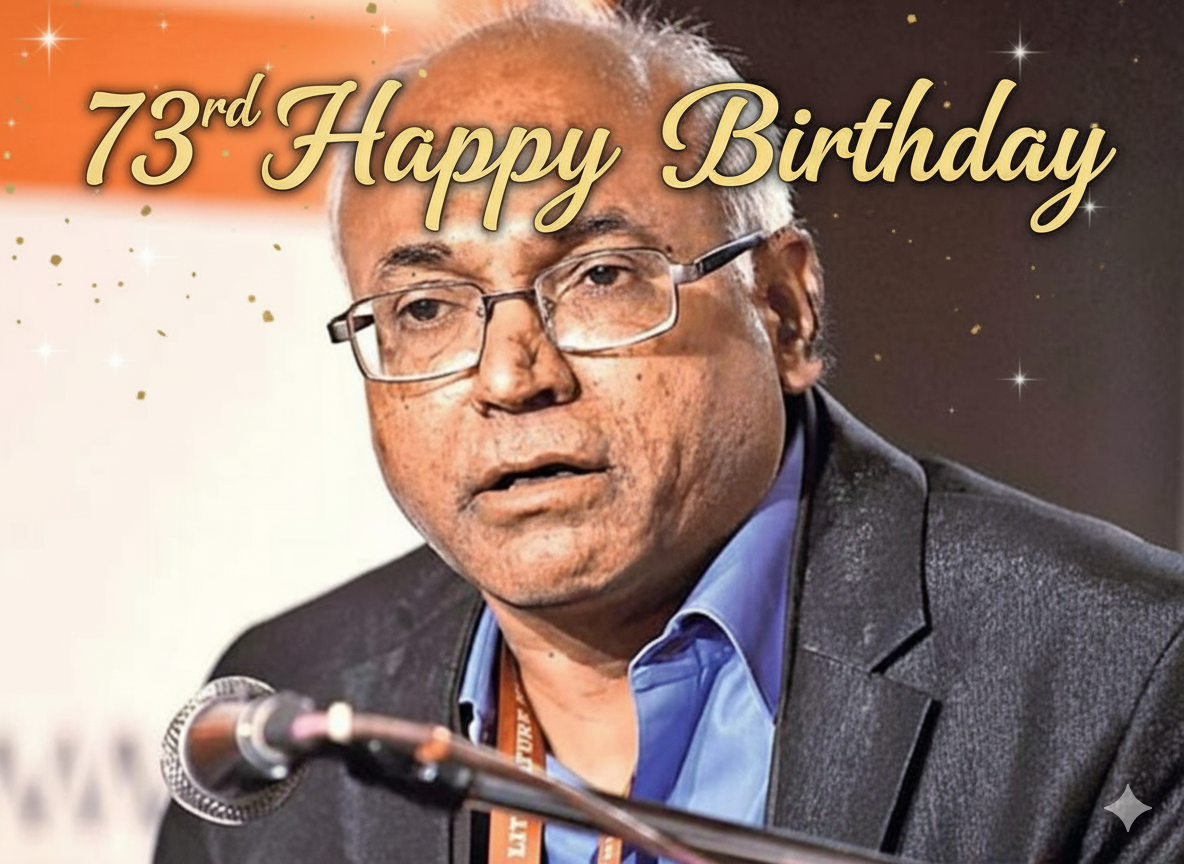

🌍📚 Celebrating Kancha Ilaiah Shepherd: A Global Intellectual from the Shepherd Community 📚🌍
Hyderabad, October 5, 2025: As the world commemorates the 208th anniversary of English education in India, today also marks the 73rd birthday of Kancha Ilaiah Shepherd, a towering figure in the fight for social justice, equality, and access to education for marginalized communities. Born into the Kuruma (shepherd) community in the village of Pappayyapeta, Warangal district, Telangana, on October 5, 1952, Ilaiah Shepherd has emerged as a global intellectual whose writings and activism have transcended borders, inspiring millions to challenge systemic oppression and embrace transformative ideas. His journey from a rural pastoralist background to becoming a revolutionary thinker is a testament to his resilience, intellect, and unwavering commitment to the emancipation of the downtrodden.

A Humble Beginning Rooted in Struggle
Kancha Ilaiah Shepherd was born to Kancha Kattamma and Komuraiah, a family deeply rooted in the Kuruma community, traditionally engaged in herding and pastoral activities. Growing up in a rural setting, Ilaiah was profoundly influenced by his mother’s strength and the labor-intensive life of his community. His father, often away herding sheep, left young Ilaiah to navigate the socio-economic challenges of a marginalized caste in a society steeped in caste hierarchies. These early experiences shaped his worldview, fueling his lifelong mission to dismantle caste-based oppression and advocate for the rights of Scheduled Castes (SC), Scheduled Tribes (ST), and Other Backward Classes (OBC).
In a bold act of defiance against Brahmanical cultural dominance, Ilaiah adopted the surname “Shepherd” to reflect his community’s identity and pride. This symbolic gesture was not merely personal but a clarion call for marginalized communities to reclaim their identities and assert their dignity through cultural and linguistic representation, including the use of English as a tool for empowerment.
A Scholar and Revolutionary Thinker
Ilaiah Shepherd’s academic journey is as inspiring as his activism. He pursued higher education at Osmania University, Hyderabad, where he later served as an Associate Professor of Political Science. His academic career also took him to Maulana Azad National Urdu University, where he was the Director of the Centre for Social Exclusion and Inclusive Policy. As a committed Ambedkarite, Ilaiah’s scholarship is deeply rooted in the principles of equality and justice espoused by Dr. B.R. Ambedkar, whose legacy continues to guide his work.
His seminal works, including Why I Am Not a Hindu (1996), Post-Hindu India: A Discourse on Dalit-Bahujan, Socio-Spiritual and Scientific Revolution (2009), The Shudra Rebellion (2021), and Turning the Pot, Tilling the Land: Dignity of Labour in Our Times (2009), have redefined the discourse on caste, class, and cultural identity in India. These books challenge the hegemony of upper-caste narratives and highlight the contributions of productive castes—Shudras, Dalits, and Adivasis—to India’s cultural and economic fabric. His writings, translated into multiple languages, have sparked global conversations about caste oppression and inspired movements for social justice.
Ilaiah’s academic contributions extend beyond India. As a Post-Doctoral Fellow with the Dalit Freedom Network in Delhi, he presented evidence of caste-based discrimination before international bodies, including the United Nations, amplifying the struggles of India’s marginalized communities on a global stage. His work has earned him recognition as a “world intellectual,” whose ideas resonate with oppressed communities worldwide.
Championing English Education for Empowerment
A cornerstone of Ilaiah Shepherd’s activism is his relentless advocacy for English-medium education in government schools, particularly for SC, ST, and OBC communities. He believes that English is not just a language but a tool for social mobility, global connectivity, and intellectual emancipation. Since the 1990s, Ilaiah has campaigned for the democratization of English education, arguing that it can break the barriers of caste and class by equipping marginalized youth with the skills to compete in a globalized world.
His efforts bore fruit in Andhra Pradesh, where he played a pivotal role in the establishment of 107 English-medium government schools, providing underprivileged children access to quality education. This initiative aligns with the broader significance of the 208th English Day, which commemorates the establishment of the first English-medium school in Kolkata in 1817. For Ilaiah, English education is a revolutionary act, enabling marginalized communities to challenge the systemic exclusion perpetuated by linguistic and cultural elitism.

A Voice That Refuses to Be Silenced
Ilaiah Shepherd’s fearless critique of caste and religious hierarchies has often placed him at the center of controversy. His book Post-Hindu India, particularly a chapter critiquing the Vysya community, sparked significant backlash in 2016, including threats and physical attacks. Despite these challenges, Ilaiah remained steadfast, continuing to speak truth to power. His resilience in the face of adversity has made him a beacon of hope for millions, particularly Dalits and Bahujans, who see in him a champion of their aspirations.
A Legacy of Liberation
As we celebrate Kancha Ilaiah Shepherd’s 73rd birthday alongside the 208th English Day, his life and ideas stand as a powerful reminder of the transformative potential of education, activism, and intellectual courage. His writings in Telugu and English, coupled with his incisive political analyses, continue to inspire future generations to fight for a more equitable society. From the pastoral fields of Warangal to the global stage, Ilaiah’s journey embodies the spirit of resistance and hope.
Today, as we honor this people’s philosopher, we recognize his contributions not only to India but to the global struggle for justice and equality. Kancha Ilaiah Shepherd remains a guiding light for the voiceless, a revolutionary mind, and a true intellectual warrior whose legacy will continue to shape the fight for a just and inclusive world.