
Assam Mourns the Loss of Zubeen Garg: 1.5 Million Attend Funeral; Global Google Record for Searches Set
Guwahati, October 8, 2025: Assam and the entire Indian music fraternity plunged into grief as the state’s most beloved cultural icon, Zubeen Garg (52), passed away on September 22 at his residence in Guwahati following a massive heart attack. The multi-talented singer, composer, lyricist, and filmmaker—fondly known as Zubeen Da—had been battling health complications for some time.
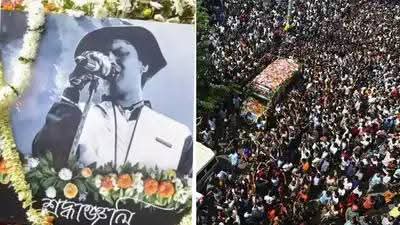
His funeral on September 24 became one of the largest gatherings in recent memory, as an estimated 1.5 million mourners thronged the streets of Guwahati to pay their final respects. The sea of humanity at his funeral has been described as the largest tribute ever accorded to an Indian artist, comparable only to the outpouring seen after Michael Jackson’s death in 2009.

Born on November 18, 1972, in Tamulpur, Zubeen’s musical journey began early. Gifted with a mesmerizing voice and a deep love for melody, he won a gold medal in Western vocals at a youth festival in 1992. His first breakthrough came in Assamese cinema with Mayabini (1995), which catapulted him into stardom across the northeastern states.
Over the next three decades, Zubeen built a musical empire, recording more than 38,000 songs in over 40 languages, including Assamese, Hindi, Bengali, Tamil, and Telugu. His versatility knew no bounds—he once recorded 13 songs in a single day, a feat unmatched in the Indian music industry. His Bollywood hit Ya Ali from Gangster (2006) remains a timeless anthem, earning him national recognition.
But Zubeen Garg was far more than just a singer. He was a composer, lyricist, screenwriter, director, actor, poet, and instrumentalist, contributing immensely to Assamese cinema. He directed and produced over 10 Assamese films, including Kangal Devota, which won critical acclaim. He revolutionized Assamese folk music by infusing it with pop and rock influences, introducing the culture of Assam to the global stage.

Tributes from Across India
Condolences poured in from political leaders, artists, and fans worldwide.
Prime Minister Narendra Modi described him as “Assam’s Kohinoor Diamond,” praising his contributions to India’s musical and cultural heritage.
Congress leader Rahul Gandhi remarked, “Zubeen Garg’s voice was the soul of Assam, echoing the emotions of an entire generation.”
Assam Chief Minister Himanta Biswa Sarma, who personally attended the funeral, said, “Zubeen Da was not merely a singer; he was a movement. His songs were not just melodies—they were reflections of our society, our struggles, and our identity.”
Industrialist Gautam Adani expressed condolences to Zubeen’s wife, Garima Saikia Garg, while Karnataka Deputy Chief Minister D.K. Shivakumar traveled to Guwahati to pay homage.
The Man Who Chose Assam Over Bollywood
Despite multiple offers from Mumbai, Zubeen famously refused to settle in Bollywood. “I’ll sing if you want, but I won’t move to Mumbai. I sing for Assam, for my people,” he once declared. His defiance of commercial fame and his deep love for his homeland made him a legend beyond music.
Born into a Brahmin family, Zubeen transcended caste and religion, often proclaiming, “I have no religion, no caste. Music is my faith.” He publicly discarded his sacred thread and became a symbol of unity in a region often divided by ethnicity and politics.
A Voice for the People
Zubeen Garg was not afraid to speak out. A vocal critic of the Citizenship Amendment Act (CAA) and National Register of Citizens (NRC), he used his music to champion social justice and cultural harmony. His songs often carried subtle messages of protest, empathy, and hope.
Beyond his artistry, Zubeen was a humanitarian in the truest sense. He reportedly donated over half of his earnings to education, healthcare, and flood relief projects in Assam. He adopted 15 underprivileged children, financing their education and futures, and converted his residence into a quarantine center during the COVID-19 pandemic. Despite his fame, he lived a simple, grounded life, often saying, “I’m not a rockstar, just one among the people.”
Assam’s Unprecedented Mourning
In the aftermath of his death, Assam virtually came to a standstill. Shops, schools, and offices remained closed as people poured onto the streets carrying his photographs and singing his songs. Hindus, Muslims, and Christians joined hands, weeping together as Zubeen’s final journey passed through the city.
Emotional scenes unfolded as thousands of youth ran behind his ambulance, chanting “Zubeen Da Amar Raho (Long Live Zubeen Da).” Even police personnel were seen crying openly, overwhelmed by the wave of collective sorrow.
On social media, tributes poured in from across the world. Within hours, Zubeen Garg became the top trending name on Google, with searches recorded from 114 of 195 countries, setting a global search record for an Indian artist’s passing.
A Legacy that Will Never Fade
Zubeen’s music continues to reverberate across Assam and beyond. Fans are revisiting his timeless songs, sharing them with the message, “Zubeen Garg Lives On.” His melodies remain part of everyday life—from children’s laughter to festive gatherings and quiet moments of reflection.
His legacy will endure as the heartbeat of Assam, the melody that unites generations, and the voice that refused to be silenced.
In every Bihu celebration, every wedding song, and every moment of joy or sorrow, Zubeen Da’s voice will continue to echo — eternally.