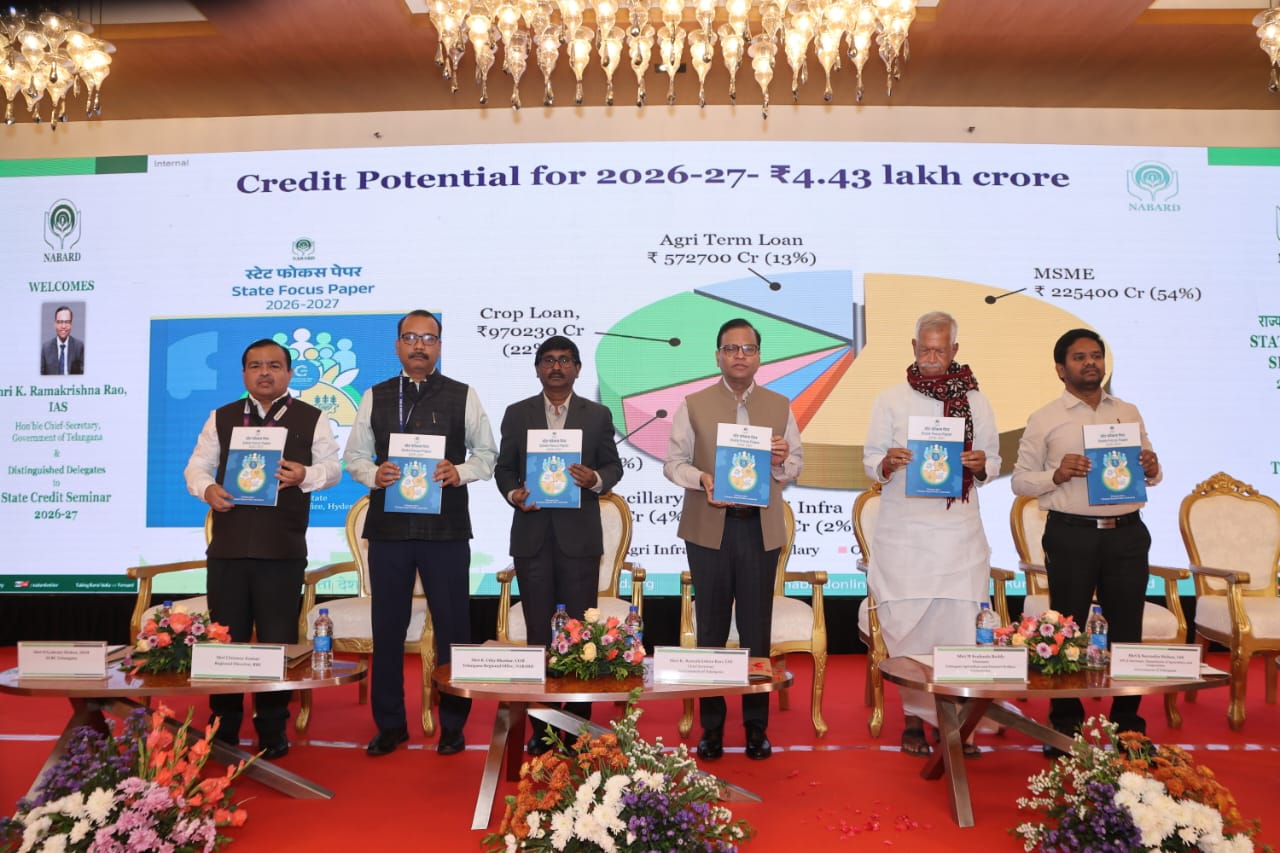

NABARD Organises State Credit Seminar 2026–27
Telangana; ₹4.43 Lakh Crore Priority Sector Credit Potential Assessed
Hyderabad, February 9, 2026:
The (NABARD) on Sunday organised the State Credit Seminar 2026–27 for Telangana in Hyderabad, marking a significant step towards strengthening bank credit flow to priority sectors, particularly agriculture and allied activities, across the State.

The seminar brought together key policymakers and stakeholders, including Kodanda Reddy, Chairman of the Telangana Farmers’ Commission; senior officials of the Government of Telangana; Chinmoy Kumar, Regional Director of the (RBI); Priyabrata Mishra, Deputy General Manager, State Level Bankers’ Committee (SLBC); representatives of commercial banks, cooperative institutions, RRBs, agricultural and horticultural universities, research institutions and other agencies engaged in rural and economic development.
On the occasion, NABARD released the State Focus Paper (SFP) for FY 2026–27, which presents a comprehensive assessment of sector-wise credit potential and the State’s absorption capacity under priority sector lending. As per the SFP, Telangana’s total priority sector credit potential has been assessed at ₹4.43 lakh crore for 2026–27, registering a 15 per cent increase over the previous year. The growth reflects robust prospects across agriculture, MSMEs, infrastructure and services.

Addressing the gathering, B. Uday Bhaskar, Chief General Manager, NABARD, Telangana Regional Office, said the State Focus Paper was prepared through a participative, district-level consultative process and would serve as the base document for formulation of the Annual Credit Plan (ACP) 2026–27 by SLBC. He noted that the SFP identifies sector-specific and region-specific opportunities across all 33 districts, while also highlighting infrastructure gaps and the need for effective policy–credit convergence to ensure inclusive growth.

Kodanda Reddy urged banks to extend greater credit support to tenant farmers, pointing out that the Government of Telangana is implementing several schemes to support the farming community. He appreciated NABARD for bringing out valuable, data-driven insights on agricultural credit potential and advised cooperative banks to adopt technology-enabled solutions for efficient delivery of crop loans.

Chinmoy Kumar, Regional Director, RBI, observed that the Telangana Rising Vision Document 2047 is well aligned with NABARD’s State Focus Paper. He acknowledged NABARD’s pivotal role in Telangana’s development through its wide-ranging initiatives in agriculture, rural livelihoods and MSMEs.
Priyabrata Mishra, DGM, SLBC/SBI, lauded NABARD for bringing out the SFP 2026–27, describing it as a crucial base document for preparing the Annual Credit Plan. He said Farmer Producer Organisations (FPOs) could provide a viable solution to the challenges in farm credit arising from fragmented landholdings.

Addressing stakeholders, K. Ramakrishna Rao, IAS, Chief Secretary to the , expressed pleasure at being associated with the State Credit Seminar, marking his first participation in the event as Chief Secretary. He appreciated the strong convergence between the Telangana Rising Vision Document 2047 and NABARD’s SFP, calling it timely and well aligned.
Explaining the State’s Three-Zone Regional Development Framework, he said the CURE area (within the Outer Ring Road) contributes nearly 60 per cent of Telangana’s GSDP, the PURE area drives manufacturing and export-oriented growth, while the RARE area remains critical for agriculture, agri-value chains, farmer incomes and food processing. He described the explicit recognition of this framework in the SFP as a radical departure from conventional credit planning.
The Chief Secretary stated that Telangana is targeting a USD 1 trillion economy by 2034 and a USD 3 trillion economy by 2047, necessitating integrated and forward-looking planning. While agriculture contributes 16–17 per cent to GSDP, it supports 46 per cent of the workforce, with an average monthly farm income of ₹9,800, underscoring the need to shift towards high-value crops, value addition and agribusiness models.

He also highlighted variations in Credit–Deposit (CD) ratios across districts and social groups, the need to tap markets beyond the State—especially in fisheries and animal husbandry—and the growing risks posed by climate change to agriculture. Stressing that the State Focus Paper should act as a guiding document, he urged banks and SLBC to align sector-wise credit plans with Telangana Rising Vision 2047 and translate them into measurable outcomes, with a special focus on farmers, SHGs and weaker sections.
The SFP places strong emphasis on agriculture and allied activities, including agricultural infrastructure, food and agro-processing, animal husbandry, fisheries and farm mechanisation. It also highlights opportunities in MSME financing, renewable energy, education, housing and social infrastructure. Key focus areas include strengthening FPOs, modernisation of cooperatives and PACS, promotion of GI-based clusters, and scaling up climate-resilient and sustainable agricultural practices.
Senior State officials underscored the relevance of the SFP as a strategic planning instrument and urged banks and financial institutions to actively align their credit strategies with the identified potentials, particularly in investment credit and infrastructure-led growth. Representatives from RBI and SLBC stressed the importance of coordinated efforts to translate assessed potential into effective ground-level credit flow.
The State Credit Seminar provided a common platform for deliberations on policy priorities, operational challenges and actionable strategies, reaffirming NABARD’s role as a catalyst and developmental partner in advancing balanced, inclusive and sustainable rural prosperity in Telangana.
Broad Sector-wise Projections and Growth (₹ lakh crore):
The total priority sector credit potential is projected to rise from ₹3.85 lakh crore in 2025–26 to ₹4.43 lakh crore in 2026–27. Farm credit is expected to grow from ₹1.39 lakh crore to ₹1.54 lakh crore (11%), agriculture infrastructure from ₹7.25 lakh crore to ₹7.81 lakh crore (8%), and ancillary activities from ₹16.15 lakh crore to ₹19.13 lakh crore (18%). Overall agricultural credit potential is estimated at ₹1.81 lakh crore, up by 11 per cent. MSME credit is projected to increase by 18 per cent to ₹2.39 lakh crore, while housing, social infrastructure and other sectors also show healthy growth, reflecting Telangana’s strong and diversified economic momentum.