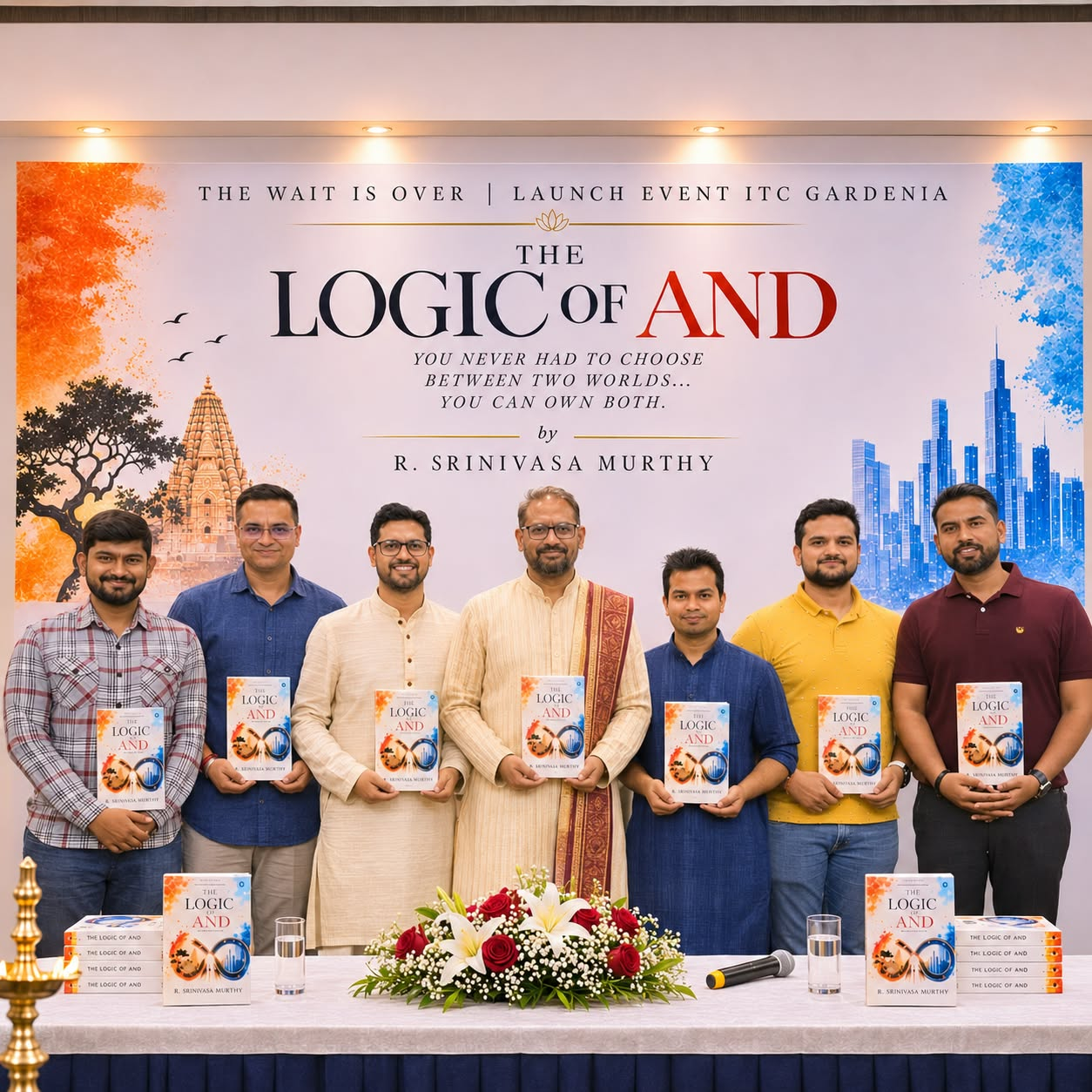
Author: R. Srinivasa Murthy
Length: 240 Pages
Bridging Ancient Wisdom and Modern Thinking
Can tradition and modernity coexist? Can spirituality embrace scientific inquiry? Can professional ambition go hand in hand with inner peace? These are some of the fundamental questions explored in The Logic of And: Sanatana Dharma as a Toolkit for the Contemporary Seeker, a 240-page book by R. Srinivasa Murthy.

Rather than presenting Sanatana Dharma merely as a collection of religious rituals, customs and beliefs, Murthy approaches it as a comprehensive civilisational philosophy that offers insights into contemporary life. The book encourages readers to look beyond inherited practices, understand their underlying principles and discover their relevance in an increasingly complex and rapidly changing world.
At the heart of the book lies a simple yet powerful proposition: life need not always be about choosing between two opposing ideas. Tradition and modernity, science and spirituality, ambition and contentment, individual freedom and collective responsibility can coexist. This philosophy of embracing apparent contradictions is what the author calls the “Logic of And”.
Sanatana Dharma as a Living Tradition
One of the most engaging aspects of the book is its central metaphor of Sanatana Dharma as a “Grand Old House”. Through this imaginative comparison, Murthy describes Indian civilisation as a living structure that has evolved over centuries, accommodating diverse ideas, philosophies, experiences and practices.
Just as a traditional house adapts to the needs of successive generations without losing its essential character, Sanatana Dharma too can accommodate new perspectives while retaining its foundational values.
The book is organised into three sections: The Blueprint, The Corridor of Synthesis and The Practitioner’s Field Kit. Together, they take readers through the foundations of Indian civilisation, its engagement with other traditions and the practical application of its philosophical principles in everyday life.
Encouraging Questions, Not Blind Acceptance
The author places inquiry and questioning at the centre of his exploration. Drawing upon personal experiences, childhood memories and observations, he examines how individuals can remain connected to their cultural roots while questioning practices they may not fully understand.
References to Charvaka philosophy, Buddhist thought and Adi Shankara demonstrate the diversity of intellectual traditions within Indian civilisation. The discussion highlights how questioning, debate and dissent have historically contributed to philosophical development.
Personal anecdotes, including an experience in Kashmir and a pilgrimage to Tirumala with a Muslim friend, add a human dimension to the discussion. These experiences illustrate how mutual respect and shared cultural experiences can transcend religious boundaries.
The book also explores concepts such as Virata Purusha and Pancha Koshas, introducing readers to different dimensions of human existence and the relationship between the individual and the larger social order.
Connecting Ancient Philosophy with Contemporary Life
The second section, “The Corridor of Synthesis”, expands the discussion to sacred geography, Dharma, environmental responsibility and comparisons between Indian and other civilisational traditions.
The treatment of Dharma is particularly relevant. Rather than presenting it as a rigid collection of rules, Murthy examines it as a framework for ethical decision-making that requires an understanding of context, responsibility and consequences.
The discussion of humanity’s relationship with nature also brings environmental consciousness into the broader philosophical narrative.
The third section, “The Practitioner’s Field Kit”, is perhaps the book’s most practical contribution. It examines how ideas from the Bhagavad Gita and the Upanishads can guide individuals through professional challenges, leadership responsibilities, personal relationships and emotional pressures.
The chapter on the “Digital Corridor” is especially relevant to today’s professionals, who constantly navigate emails, deadlines, performance reviews and workplace expectations.
Murthy interprets the Bhagavad Gita’s principle of Nishkama Karma as the ability to perform one’s duties with commitment and excellence without becoming excessively attached to outcomes. Importantly, he distinguishes this approach from indifference or a lack of ambition.
Practical exercises such as the “Third Room” and “Kosha Audit” encourage readers to examine their decisions, understand the sources of stress and look beyond conventional either-or choices.
A Meeting of Spiritual and Professional Perspectives
The book gains additional significance through its introductory contributions and endorsements from personalities belonging to different fields.
A Sandesham by Dr Sri Sri Ganapathi Sachchidananda Swamiji and a foreword by internationally acclaimed motivational speaker and bestselling author Priya Kumar bring together spiritual wisdom and contemporary leadership perspectives.
The contributions from Justice Raghunandan Rao, former Andhra Pradesh High Court judge; Dr TVSN Prasad, former Chief Secretary and Chief Information Commissioner; and Ambassador R. Chandramouli, former Indian Ambassador to Djibouti, add to the diversity of perspectives surrounding the publication.
The endorsements also include voices from academia, corporate leadership, technology, finance, the armed forces and creative industries.
An especially interesting inclusion is Y. Srinivasa Rao, who identifies himself as an ethical and vocal atheist. His appreciation of the book underlines the possibility of engaging with Sanatana Dharma through intellectual curiosity rather than religious conviction.
While these contributions represent advance endorsements rather than independent reader assessments, their diversity reflects the book’s central theme of bringing different perspectives into conversation.
Strengths and Areas for Deeper Exploration
One of the book’s greatest strengths is its accessible and conversational style. Murthy does not position himself as a scholar or theologian. Instead, he presents the work as the outcome of years of reading, observation, conversations and personal reflection.
This approach makes complex philosophical ideas approachable, particularly for younger readers and professionals who want to understand the intellectual foundations of Indian traditions.
However, readers seeking detailed academic research, historical documentation or rigorous textual interpretations may find some discussions relatively broad. Certain explanations of traditional practices and civilisational comparisons could have benefited from more extensive evidence and qualification.
The recurring Grand Old House metaphor, although effective as a connecting theme, occasionally feels repetitive.
Nevertheless, these limitations do not diminish the book’s central purpose: encouraging readers to engage with their inheritance thoughtfully rather than accepting or rejecting it unquestioningly.
A Meaningful Conversation Between Generations
The book’s prologue and dedication offer another important dimension. Through references to his father and son, Murthy reflects on the relationship between inherited wisdom and independent questioning.
The older generation represents continuity, while the younger generation symbolises curiosity and the courage to question established ideas. The author brings these perspectives together to suggest that cultural inheritance should inspire exploration rather than restrict it.
One of the most memorable ideas emerging from the book is that inheritance should provide a map, not dictate the journey.
Verdict: An Invitation to Think Beyond Opposites
The Logic of And: Sanatana Dharma as a Toolkit for the Contemporary Seeker is a thoughtful and accessible exploration of how India’s ancient philosophical traditions can offer meaningful perspectives on modern challenges.
Its appeal lies not in claiming to provide definitive answers, but in encouraging readers to ask better questions. It invites people to remain rooted in tradition without becoming rigid, embrace modernity without abandoning their cultural identity, and pursue professional success without losing sight of inner well-being.
The book will particularly interest young professionals, students, culturally curious readers and those who grew up in traditional Indian families but now seek a deeper understanding of the ideas behind their customs and beliefs.
In an age increasingly dominated by polarised opinions and binary choices, R. Srinivasa Murthy makes a compelling case for a more inclusive and balanced approach to life.
Ultimately, the book’s message is both simple and relevant: one need not choose between tradition and progress, faith and reason, or ambition and inner peace. There is room for both.
That, indeed, is the Logic of And.