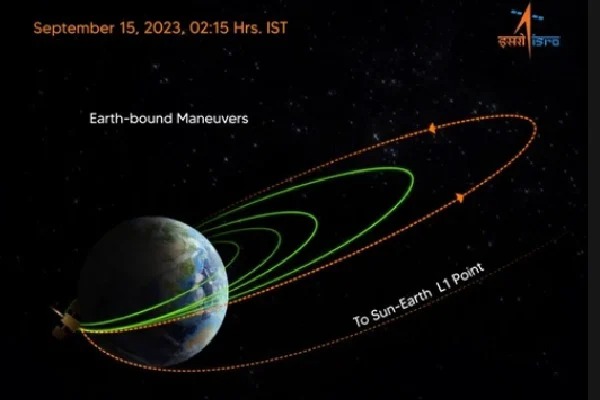

Banglore, September 15, 2023:- India’s space agency, the Indian Space Research Organisation (ISRO), announced that the Aditya-L1 space-based solar observatory is set for its journey towards the Sun on September 19. This significant milestone will involve maneuvering the spacecraft to Trans-Lagrangian Point 1 Insertion (TL1I), marking a critical step in its mission.

On Friday, ISRO reported the successful completion of the fourth Earth-bound maneuver at 2:15 a.m. This maneuver was closely monitored by ISRO’s ground stations located in Mauritius, Bengaluru, SDSC-SHAR, and Port Blair. Additionally, a transportable terminal in the Fiji islands, dedicated to the Aditya-L1 mission, will support post-burn operations.
The new orbit achieved through these maneuvers measures 256 km x 121973 km, signifying the spacecraft’s steady progression towards its destination.
The upcoming maneuver, Trans-Lagrangian Point 1 Insertion (TL1I), scheduled for September 19 at approximately 2 a.m., will serve as a pivotal moment as Aditya-L1 prepares to leave Earth’s gravitational influence.
Aditya-L1, India’s pioneering space-based solar observatory, was initially placed in a low Earth orbit (LEO) on September 2, thanks to the Indian Polar Satellite Launch Vehicle–XL (PSLV-XL) variant. Since then, ISRO has elevated the spacecraft’s orbit on four occasions.
As Aditya-L1 embarks on its journey toward the Lagrange Point (L1), it will gradually depart from Earth’s gravitational Sphere of Influence (SOI). Following this exit, the cruise phase will commence, ultimately leading to the spacecraft’s insertion into a vast halo orbit around L1. This unique position allows the spacecraft to remain in equilibrium between the gravitational forces of two massive celestial bodies—the Sun and Earth.
The mission’s entire duration, from launch to reaching L1, is estimated to span approximately four months, covering a distance of roughly 1.5 million kilometers from Earth. The Aditya-L1 mission represents a significant leap in India’s space exploration endeavors and promises valuable insights into solar activity.