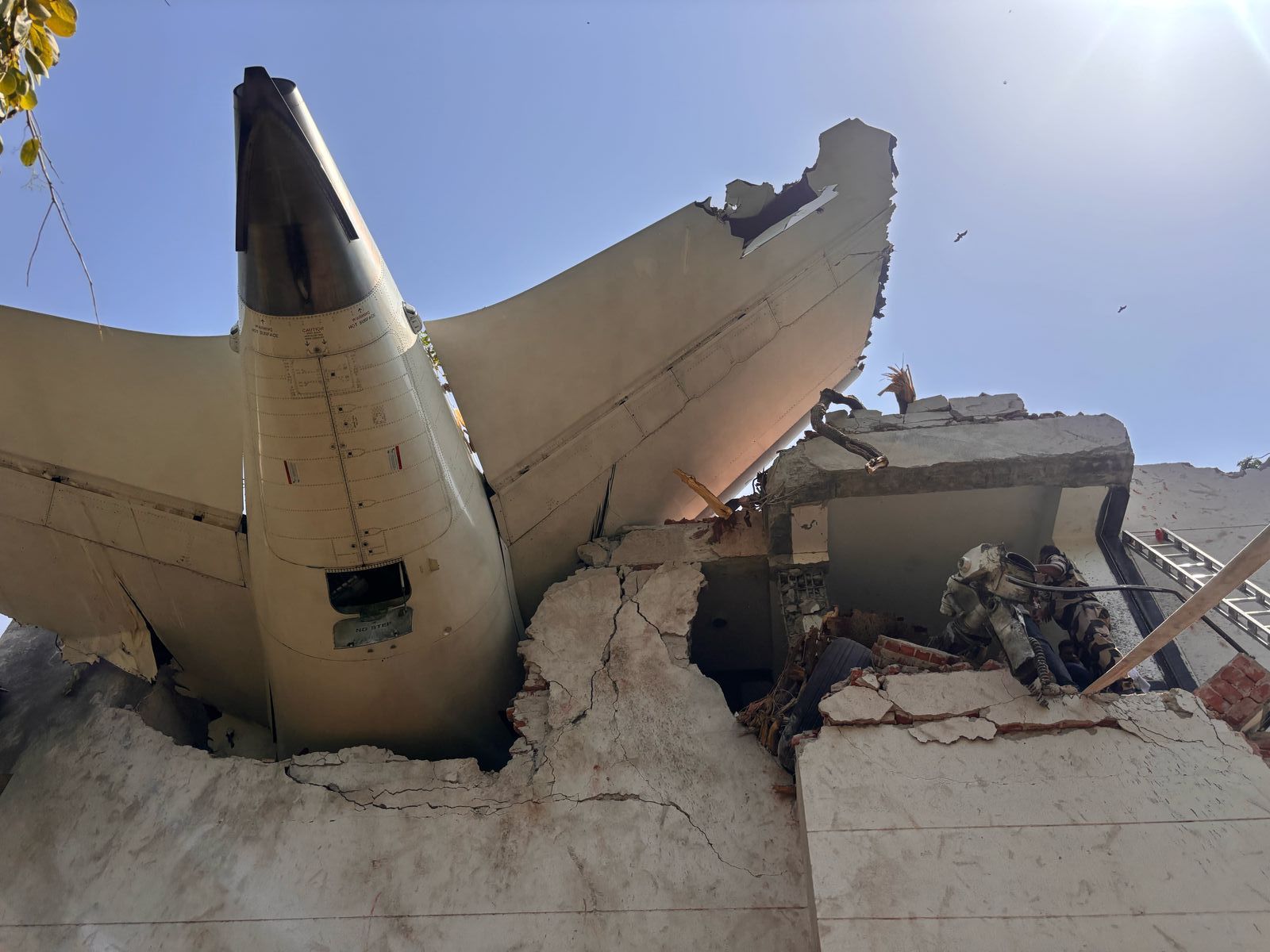

Air India 787 Crash Blamed on Pilot Error, Not Mechanical Failure, Say U.S. Investigators
New Delhi, July 11, 2025 – A catastrophic crash involving an Air India Boeing 787 Dreamliner earlier this year has been attributed to human error, with U.S. investigators concluding that pilot actions—not mechanical failure—caused the fatal accident. The revelation absolves both Boeing and General Electric (GE), whose engines power the aircraft, of any direct technical responsibility.
According to a detailed report by The Wall Street Journal, U.S. officials involved in the investigation revealed that the flight crew mistakenly turned off critical fuel control switches mid-flight, shortly after takeoff. These switches are designed exclusively for use during engine startup or in emergency scenarios and should not be engaged during normal flight operations.
The tragic accident claimed the lives of nearly all passengers and crew members aboard the flight, leaving only one survivor. The lone survivor, whose identity has been withheld, was miraculously pulled from the wreckage and is undergoing medical treatment. Officials have not released details regarding their condition or any statement from the survivor, as the investigation remains active.


Shocking Misstep in the Cockpit
Preliminary findings suggest there was no in-flight emergency that warranted any manual intervention with the fuel switches. The pilots’ action led to an immediate and total loss of thrust, causing the aircraft to rapidly lose altitude and crash. Investigators have described the error as a grave deviation from standard operating procedures.
“This kind of mistake—disabling the fuel supply to both engines—is virtually unthinkable in a commercial aviation context,” said John Carter, a retired pilot and aviation safety consultant. “It signals a significant lapse in cockpit discipline, procedural adherence, or perhaps even a deeper issue within pilot training.”

The U.S. National Transportation Safety Board (NTSB), which is collaborating with Indian aviation authorities on the probe, has now focused the investigation on human factors. Key areas under scrutiny include:
- Crew training and qualifications
- Cockpit resource management (CRM)
- Potential miscommunication between pilots
- Possible fatigue or cognitive overload
Sources indicate that the cockpit voice recorder and flight data recorder—recovered shortly after the crash—are being analyzed to reconstruct the sequence of events leading to the fatal incident.
Air India Under Pressure
In response to growing criticism, Air India issued a brief statement expressing condolences and pledging full cooperation with the inquiry. “We are deeply saddened by this tragedy. Our thoughts remain with the families of the victims. Air India is committed to identifying and addressing any issues that contributed to this incident,” said an airline spokesperson.
The airline, a key player in India’s civil aviation sector and currently undergoing a transformation under the Tata Group, has faced increasing scrutiny over safety, maintenance, and training standards in recent years. Indian aviation regulators have now announced an urgent review of Air India’s pilot training protocols, simulator sessions, and flight crew assessment systems.
“This incident is a wake-up call,” said an official from the Directorate General of Civil Aviation (DGCA). “We cannot afford lapses in training and safety culture, especially when operating advanced aircraft like the Boeing 787.”
Boeing and GE Cleared of Fault
Boeing and GE, both of which faced questions in the immediate aftermath of the crash, have now been cleared of any mechanical or software malfunctions. Technical reviews confirm that the aircraft systems and engines performed as designed. This finding comes as a relief to Boeing, whose 787 Dreamliner has previously come under global scrutiny for other unrelated issues, including battery fires and quality control lapses at some production facilities.
Broader Implications for Aviation Safety
The crash has sparked renewed global discussions on pilot competency and cockpit resource management. Aviation experts emphasize that even the most advanced aircraft are still vulnerable to human mistakes.
“Technology can only go so far,” said aviation psychologist Dr. Leena Sharma. “When basic operational procedures are misunderstood or misapplied, the consequences can be catastrophic.”
International aviation bodies, including the International Civil Aviation Organization (ICAO), have called for a review of CRM training standards and fatigue management systems across the industry.
Families of the victims have demanded transparency and accountability, urging both Indian authorities and Air India to publish the full findings once the investigation concludes. Some have even called for an independent judicial inquiry, alleging systemic lapses in safety oversight.

Survivor May Hold Key to Final Report
Investigators are expected to release an interim report in the coming weeks, while the final findings could take several more months. Meanwhile, the sole survivor’s eventual testimony could provide crucial insights into the cockpit environment, communication breakdowns, or other anomalies prior to the crash.
As the aviation industry watches closely, this tragedy underscores the critical importance of human factors in modern air travel—reminding the world that even in an era of automation and cutting-edge technology, skilled and vigilant crew members remain the most essential element of flight safety.