
Massive 8.8 Magnitude Earthquake Rocks Russia’s Kamchatka Peninsula, Triggering Tsunami and Pacific-Wide Alerts
PETROPAVLOVSK-KAMCHATSKY, Russia — A colossal 8.8 magnitude earthquake, one of the sixth strongest in recorded history, struck off the eastern coast of Russia’s Kamchatka Peninsula on Wednesday, July 30, 2025, unleashing a powerful tsunami that battered coastal areas and prompted urgent evacuation orders across the Pacific Rim. The quake, centered approximately 119 kilometers (74 miles) east-southeast of Petropavlovsk-Kamchatsky, has caused significant structural damage and triggered widespread concern as tsunami warnings remain in effect for multiple countries.

Tsunami Devastates Russia’s Far East
The earthquake, which struck at 1:25 p.m. Hawaii Standard Time (8:25 a.m. Japan time), generated tsunami waves as high as 3 to 4 meters (10 to 13 feet) that inundated parts of Russia’s Kamchatka region, including the port town of Severo-Kurilsk in the Sakhalin Oblast. Drone footage revealed buildings submerged in seawater and debris scattered across the shoreline, with approximately 2,000 residents evacuated to higher ground. Kamchatka Governor Vladimir Solodov described the quake as “serious and the strongest in decades,” noting damage to a kindergarten in Petropavlovsk-Kamchatsky, a city of 165,000 residents. While several people sustained minor injuries, no serious casualties have been reported so far, according to regional health minister Oleg Melnikov.

Japan Braces for Impact
In Japan, the Meteorological Agency issued a tsunami alert for the Pacific coast, stretching from Hokkaido to Wakayama Prefecture, warning of potential waves up to 3 meters (9.8 feet). Initial waves of approximately 30 to 50 centimeters (1 to 1.6 feet) were recorded in Nemuro, Hokkaido, and Ishinomaki, with authorities cautioning that larger waves could follow. Over 900,000 residents across 133 municipalities were ordered to evacuate, with footage showing people seeking shelter on rooftops and fishing boats fleeing harbors to avoid damage. The Fukushima Daiichi nuclear plant, site of the 2011 disaster, was evacuated as a precaution, though operator TEPCO reported no abnormalities. Japan’s Chief Cabinet Secretary Yoshimasa Hayashi urged residents to remain vigilant, emphasizing that “tsunamis can strike repeatedly.”
Pacific-Wide Tsunami Alerts
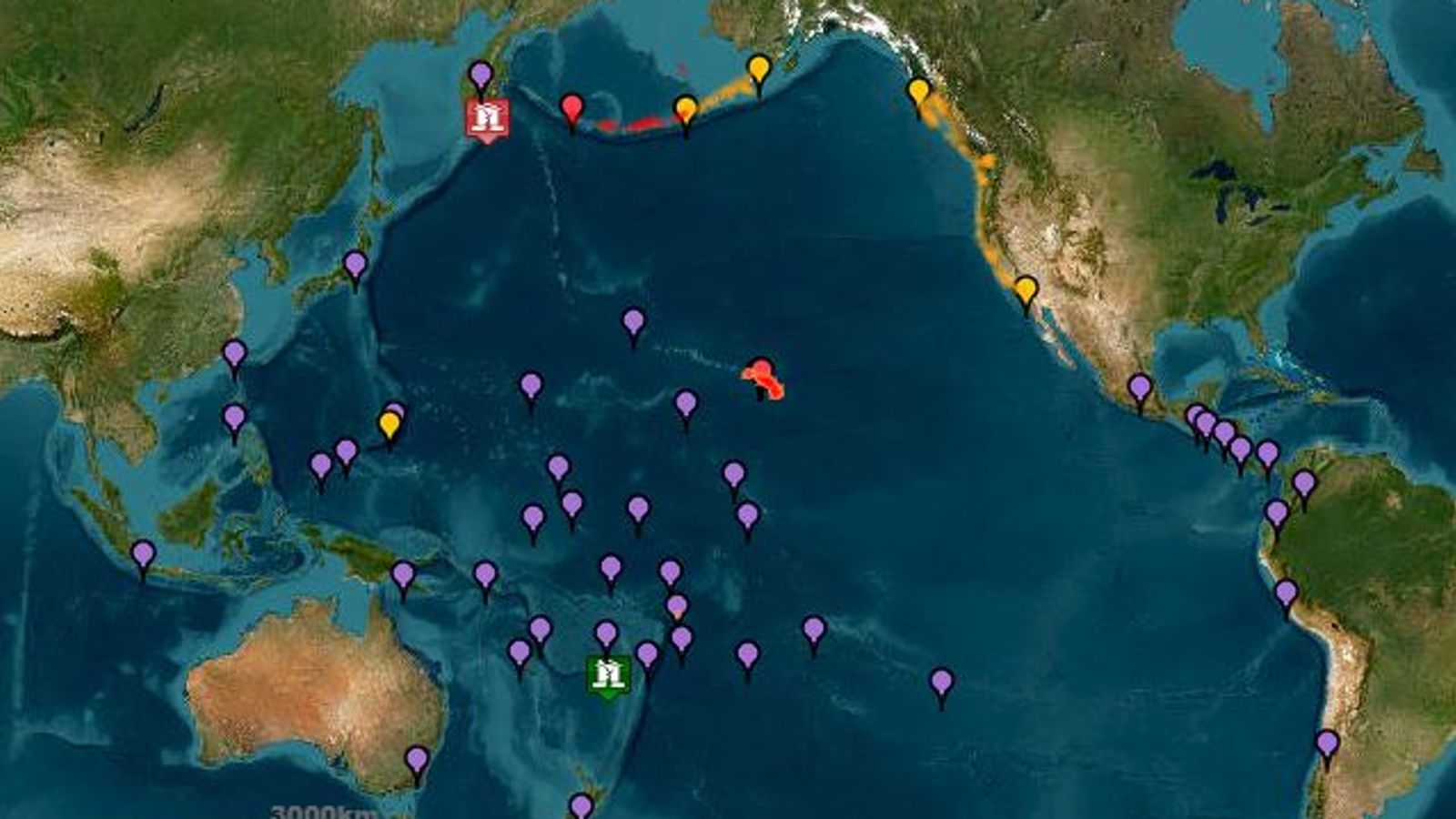
The Pacific Tsunami Warning Center (PTWC) issued warnings for hazardous waves across a vast region, with potential impacts in Hawaii, Alaska, Chile, Ecuador, the Solomon Islands, and other Pacific nations. Waves exceeding 3 meters were deemed possible along some coasts of Russia and Ecuador, while waves of 1 to 3 meters were forecast for Japan, Hawaii, Chile, and the Solomon Islands. Smaller waves, ranging from 0.3 to 1 meter, were expected in countries such as the Philippines, Indonesia, Taiwan, and China’s eastern seaboard.
In Hawaii, tsunami warning sirens blared across the islands, with the first waves expected around 7:10 p.m. local time (1:10 a.m. ET). Governor Josh Green issued an emergency proclamation, urging residents to evacuate coastal areas immediately. “If you stay on the beaches, you could risk death,” Green warned, emphasizing the need to seek higher ground or take shelter on at least the fourth floor of a building. Traffic gridlock was reported in Honolulu as residents fled to safety, and Hilo International Airport suspended commercial flights to facilitate evacuations.
On the U.S. West Coast, a tsunami warning was issued for California’s North Coast, from Cape Mendocino to the Oregon border, with advisories in place for southern California, Oregon, Washington, and parts of Alaska. Canadian authorities issued a tsunami watch for coastal British Columbia, while New Zealand warned of “strong and unusual currents” along its shores. Ecuador ordered preventive evacuations in the Galápagos Islands, and Peru and Mexico mobilized authorities to keep people away from Pacific beaches.
Seismic Context and Aftershocks
The earthquake, initially reported at 8.0 and later upgraded to 8.8 by the U.S. Geological Survey (USGS), occurred at a shallow depth of 19.3 kilometers (12 miles), amplifying its destructive potential. The Kamchatka Peninsula, located on the Pacific Ring of Fire, is a seismically active region prone to earthquakes and volcanic eruptions. The Russian Academy of Sciences noted that this was the strongest quake to hit the area since a 9.0 magnitude event in 1952, which triggered 9.1-meter waves in Hawaii. Multiple aftershocks, including two measuring 6.3 and 6.9, rocked the region, with experts predicting significant aftershocks for weeks.
Global Response and Ongoing Monitoring
U.S. President Donald Trump addressed the crisis on social media, urging residents in affected areas to “stay strong and stay safe” and directing them to tsunami.gov for updates. In Japan, Prime Minister Shigeru Ishiba called for immediate evacuations, while local governments suspended train services on 41 lines and closed parts of three expressways to ensure safety. The Indian Consulate in San Francisco issued guidelines for residents in tsunami-affected areas, and China’s Tsunami Advisory Center warned of potential coastal impacts.
As the situation develops, authorities across the Pacific continue to monitor wave activity, with the PTWC warning that tsunamis can involve multiple waves over hours or even days. Residents in vulnerable areas are urged to follow local alerts, avoid coastlines, and remain in safe locations until warnings are lifted.
For the latest updates, visit tsunami.gov or follow local emergency management agencies. This is a developing story, and further details will be provided as they become available.