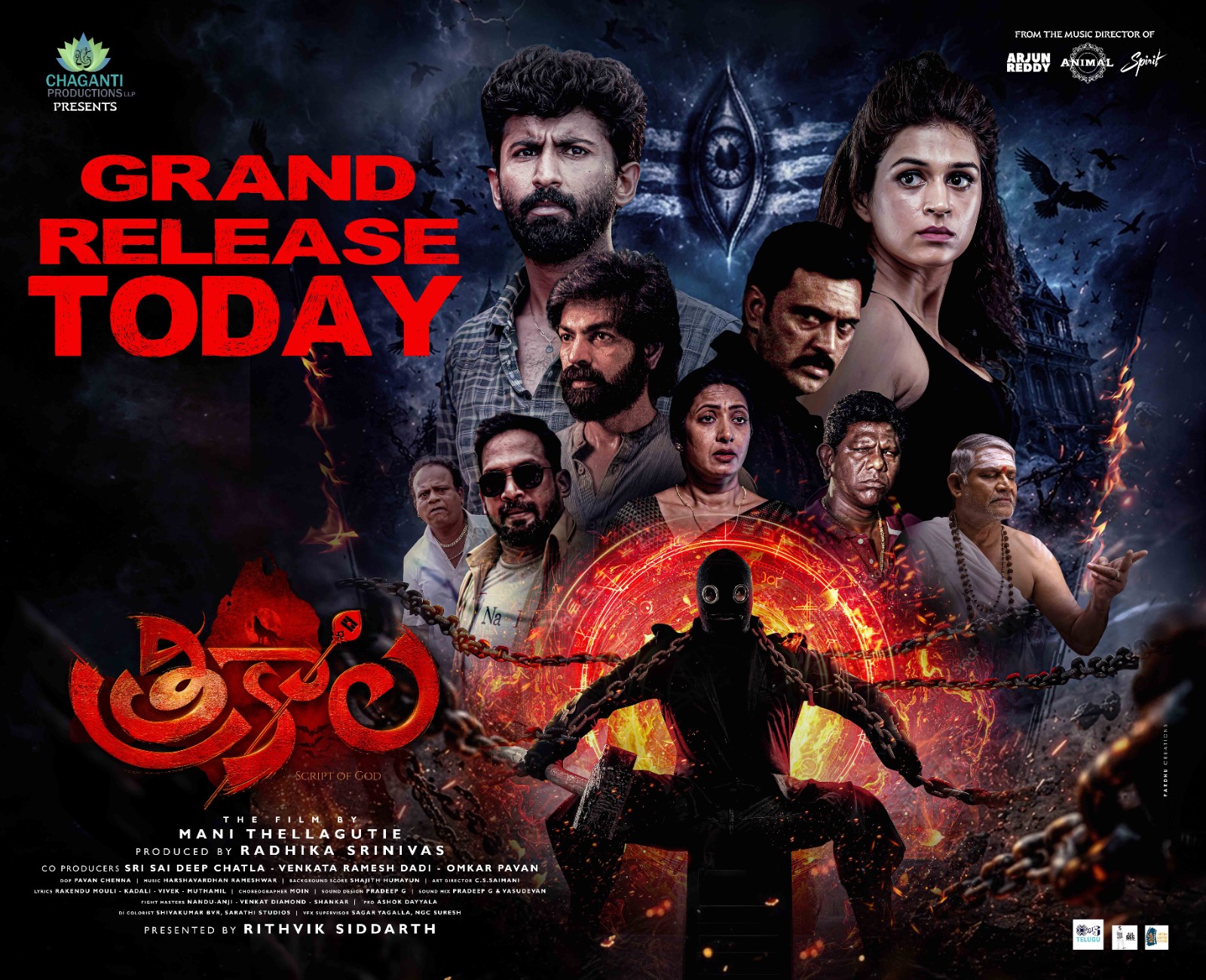

‘Trikaala’ Movie Review: A Visually Rich Mythological Dark Thriller
Rating: 3.5/5
Trikaala: A Script of God is a new-age mythological dark thriller that blends karma philosophy, reincarnation, tantric powers, psychological fear, and emotional drama into a visually immersive cinematic experience. Directed by Mani Tellagooti, the film had already created curiosity with its teaser, trailer, and posters, reminding audiences of dark mystical worlds seen in films like Tumbbad and Kantara. Released worldwide by Chaganti Productions, Trikaala attempts to create a unique mythological horror universe on the big screen.
Story
The story begins centuries ago in the mythical land of Kumari Khandam, where sages hide powerful tantric scriptures and ancient technological secrets to prevent them from falling into the hands of demonic forces. To protect these secrets, they create a divine weapon called Shakti Aetha and entrust it to warrior king Trikaal Varma.
During a fierce battle against evil forces, Trikaal Varma dies, and the sages imprison his soul inside a mystical cosmic egg, predicting that he will awaken again in the Kali Yuga when humanity faces its greatest threat.
In the present day, Shiva (Master Mahendran) arrives in the city in search of his missing lover, Nidhi (Sahithi). He carries a haunted mobile phone possessed by dark energy. During his search, he discovers the mysterious Vaitaran (Ajay), a man suffering from porphyria, a rare condition that prevents him from tolerating sunlight. However, Vaitaran is actually the reincarnation of Trikaal Varma.
Tormented by emotional trauma and psychological conflict, Vaitaran murders his father and stepmother, played by Aamani, before taking his own life. Yet, his spirit continues to haunt a terrifying mansion. Psychiatrist Maya (Shraddha Das) becomes trapped inside the house, while an ancient demon king prepares to rise again and reclaim dominance over Earth.
How the Darwadi tantric tribe reactivates the mystical cosmic egg, how Trikaal Varma’s soul returns, and what Shiva’s true connection is to this supernatural battle form the core of the story.
Plus Points
The strongest aspect of Trikaala is undoubtedly its concept. Rather than simply discussing karma and reincarnation through dialogues, the film visualizes these themes through layered character arcs, psychological trauma, and spiritual conflict. The blend of mythology with modern-day horror gives the film a fresh cinematic identity.
Ajay delivers one of the film’s most memorable performances as Vaitaran. His portrayal of a mentally disturbed man trapped between darkness, fear, and supernatural forces is intense and haunting. The specially designed masks, costumes, and dark visual styling around his character add depth to the role.
Master Mahendran gives a natural and emotionally engaging performance. He handles innocence, fear, romance, and emotional breakdowns with ease, especially in the climax portions where his emotional scenes connect strongly with the audience.
Shraddha Das is another major highlight. Her role carries more mystery than glamour, and she delivers a controlled yet impactful performance as psychiatrist Maya. Her screen presence enhances the film’s dark tone, particularly during the horror and emotional sequences.
Veteran actress Aamani also leaves a strong impact. She portrays motherhood, fear, emotional pain, and suspicion with remarkable authenticity, adding emotional weight to the narrative.
Direction and Technical Values
Director Mani Tellagooti proves himself to be a technically strong filmmaker with a clear cinematic vision. Unlike conventional filmmakers who focus on VFX only during post-production, Mani appears to have designed every frame visually right from the scripting stage.
Each shot in Trikaala follows a distinct dark visual language. Through shadow-heavy frames, empty corridors, dim lighting, and slow camera movements, he builds a haunting atmosphere that constantly creates suspense and uneasiness. The film often feels like an expansive dark mystic universe.
His editing approach also stands out. Instead of relying on commercial fast-cut editing, the film focuses more on cinematic rhythm, sound design, and visual mood. Even the trailer shots feel designed specifically for a theatrical big-screen experience.
One of the film’s biggest strengths is how it achieves a grand scale despite not relying heavily on massive physical sets. Through smart frame composition, CGI backdrops, and digital extensions, Mani creates visuals that often resemble Hollywood dark fantasy cinema.
Cinematography
Cinematographer Pawan Channa elevates the film significantly with his visual storytelling. His camera captures not just the characters but also the emotions hidden within every frame.
The lighting design is exceptional, especially in scenes involving mythology, ancient temples, haunted mansions, and spiritual warfare. The use of deep black tones combined with golden light beams creates a rich mystical atmosphere.
Several frames resemble gothic paintings, giving the movie an international dark fantasy aesthetic. The use of shadows in Vaitaran’s scenes, wide-angle shots inside ancient caves, and dimly lit temple corridors leave a lasting visual impact.
Particularly in the horror sequences, the slow and uncomfortable camera movements make viewers feel trapped within the fear itself. In many scenes, tension is created purely through lighting and framing rather than jump scares.
Music and Background Score
Music by Harshavardhan Rameshwar, known for films like Arjun Reddy and Animal, becomes one of the film’s biggest assets. His compositions and sound textures elevate the dark emotional atmosphere effectively.
Additionally, Shajith Humayun’s background score gives life to the horror and tantric sequences. In several scenes, sound design takes precedence over traditional music, making the experience more immersive and unsettling.
VFX and Production Values
VFX plays a crucial role in Trikaala. The mystical cosmic egg, demonic powers, ancient worlds, and spiritual battle sequences are designed impressively. The CGI never feels excessive and blends naturally into the storytelling.
The interval block especially stands out with its visually stunning VFX work. The combination of practical lighting and CGI integration gives many scenes a realistic fantasy feel.
Producer Radhika Srinivas has mounted the film with rich production values. Every frame reflects quality in terms of costumes, set design, VFX, colour grading, and technical presentation. Supporting a visually ambitious concept like this shows the producer’s confidence in experimental storytelling.
Final Verdict
Trikaala is not a routine horror film. It is a blend of mythology, psychological horror, dark fantasy, and visual thriller elements. Its storytelling, visuals, background score, and technical execution combine to create a unique cinematic experience.
With mythological mysteries, karma philosophy, spiritual concepts, and Hollywood-style dark visuals, Trikaala offers something fresh for audiences looking beyond conventional commercial cinema. Fans of mystical thrillers and atmospheric dark fantasy films are likely to enjoy this immersive experience.
Verdict: A visually rich mythological dark thriller with a fresh concept and strong technical execution.
Rating: 3.5/5