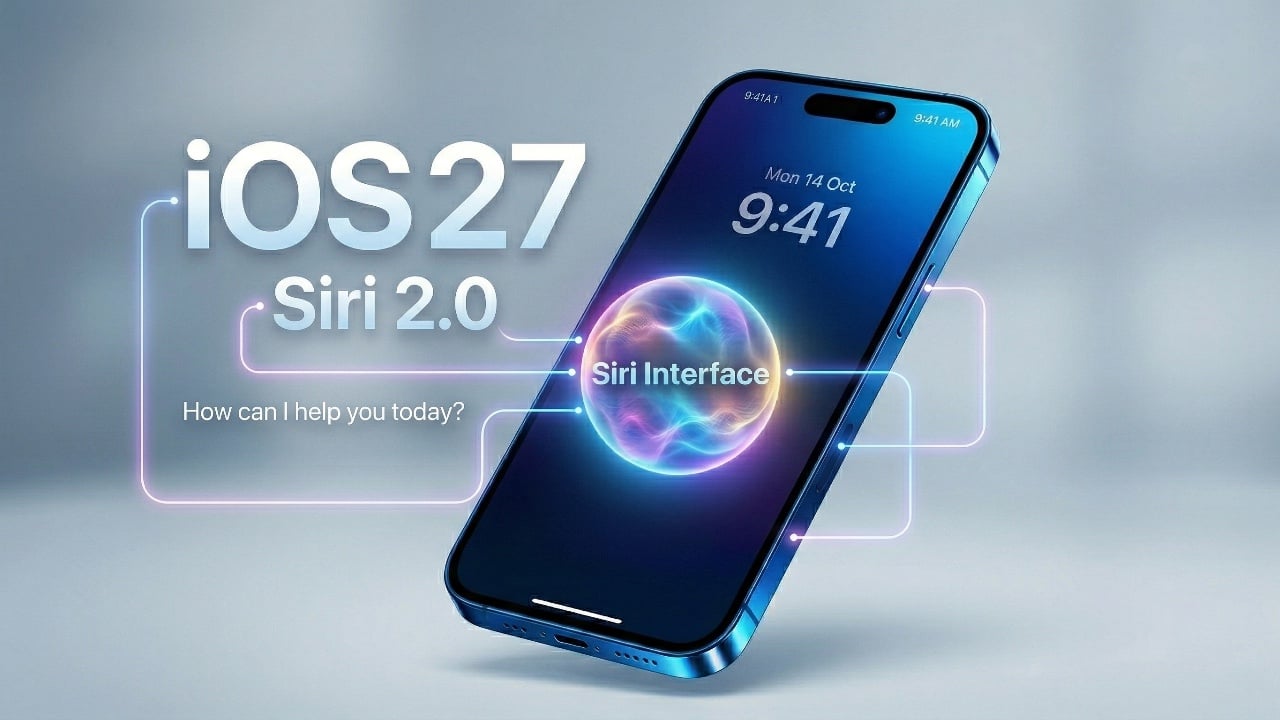

Human-Like Siri, Touchscreen MacBooks & M4 Power Set to Redefine Tech
Apple Prepares Transformational Leap with ‘Human-Like’ Siri in iOS 27, Touchscreen Macs and M4 Power Push
Hyderabad, April 20, 2026: Apple Inc. is gearing up for one of the most significant upgrades in its history, with reports indicating a sweeping transformation across its ecosystem—spanning iPhones, MacBooks, and professional computing devices. At the heart of this evolution lies a radically redesigned Siri, expected to debut with iOS 27, that promises to behave less like a voice tool and more like a truly intelligent digital assistant.

Next-Generation Siri: From Assistant to Autonomous Agent
The upcoming version of Siri is being positioned as a “human-like” AI system capable of understanding complex natural language, reasoning through multi-step instructions, and executing tasks independently. Unlike current voice assistants that rely on command-based triggers, the new Siri will function with contextual awareness and decision-making capabilities.
For example, a user could say: “Find the photos I took in Goa last week, enhance them, and share them via WhatsApp,” and Siri would autonomously complete the entire workflow—without requiring manual intervention. This marks a fundamental shift from reactive assistance to proactive task execution.
Additionally, Siri is expected to gain real-time on-screen awareness, enabling it to analyze what the user is viewing and offer contextual suggestions or actions instantly. This could significantly reduce friction in everyday smartphone usage and make interactions more intuitive and conversational.

Apple Breaks Tradition with Touchscreen MacBooks
In a notable departure from its long-standing design philosophy, Apple is reportedly preparing to introduce touchscreen functionality to its MacBook lineup—starting with the MacBook Pro. Historically resistant to touch-enabled laptops, Apple appears to be aligning with evolving user expectations.
The new MacBooks are expected to feature advanced OLED displays, offering richer color accuracy and energy efficiency. With touchscreen support, users will be able to perform gestures such as dragging files, sketching, annotating, and navigating directly on the screen—bringing the Mac experience closer to that of the iPhone and iPad, while still retaining desktop-level performance.

M4 Chips to Power Next-Gen Performance
Apple is also set to unveil updated Mac Studio models powered by its next-generation M4 silicon. These chips are expected to deliver a substantial leap in performance—potentially doubling processing power compared to previous iterations—while maintaining superior energy efficiency.
The M4 architecture is likely to enhance capabilities across high-performance workflows, including 4K/8K video editing, 3D rendering, AI model training, and advanced gaming. With improved neural engines, the chips will also play a central role in enabling on-device artificial intelligence features.
Privacy-Centric AI: On-Device Processing
A defining aspect of Apple’s strategy remains its commitment to privacy. Unlike many competitors that rely heavily on cloud-based AI processing, Apple is doubling down on on-device intelligence.
In iOS 27, most AI computations—including those performed by Siri—will occur directly on the device. This ensures that sensitive data such as personal photos, messages, and usage patterns remain secure and are not transmitted to external servers. The approach not only enhances security but also improves speed and responsiveness.
Strategic Investment and Industry Impact
Apple is reportedly investing over ₹8,300 crore (approximately $1 billion) into developing its M4 chips and AI infrastructure. This signals a long-term commitment to integrating advanced artificial intelligence deeply into its ecosystem.
Renowned tech analyst Mark Gurman has described these developments as a “turning point” for Apple. According to him, the company is gradually moving away from rigid design doctrines to embrace user-driven innovation. The introduction of touchscreen Macs, in particular, represents a historic shift in Apple’s product philosophy.
A New Era of Human-Centric Computing
With iOS 27 and its broader hardware upgrades, Apple appears poised to redefine how users interact with technology. The evolution of Siri into a “robot-like” assistant capable of reasoning, acting, and adapting could blur the line between software and human interaction.
If these advancements materialize as expected, using an iPhone or Mac may soon feel less like operating a device and more like engaging with an intelligent companion—marking the beginning of a new era in personal computing.